Music Stands · 2026-08-28
Best Music Stands for Electric Violinists Who Play Weddings, Theater Pits, and Outdoor Sets
For most electric violinists who still need real charts at weddings, theater pits, corporate shows, and outdoor sets, the best overall music stand is the K&M 11870 because it gives you a real orchestra-size desk, a quick-release design, and a folded size that is easier to carry than many classic stands. If you want the most familiar solid-desk feel, buy the Manhasset Voyager. If low weight and price matter most, choose the Peak SMS-40. For a premium fold-flat upgrade, the RATstands Jazz Stand Pro makes the most sense.
Follow Tanya Strings on Google
Add the site as a preferred source to see more new violin posts from Tanya Strings in Google.
Some links in this article are affiliate links. I may earn a commission if you make a purchase, at no extra cost to you.
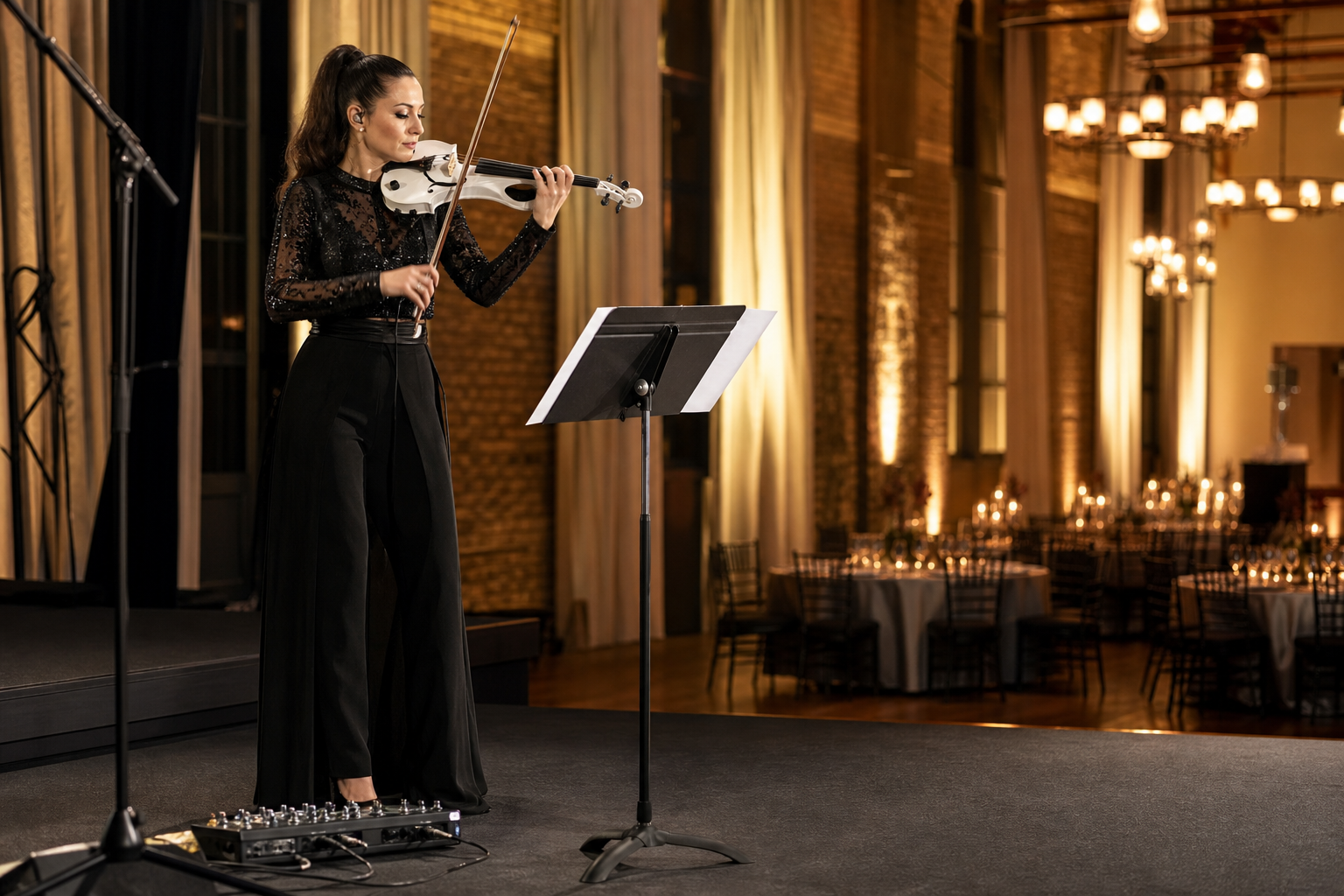
What are the best music stands for most electric violinists?
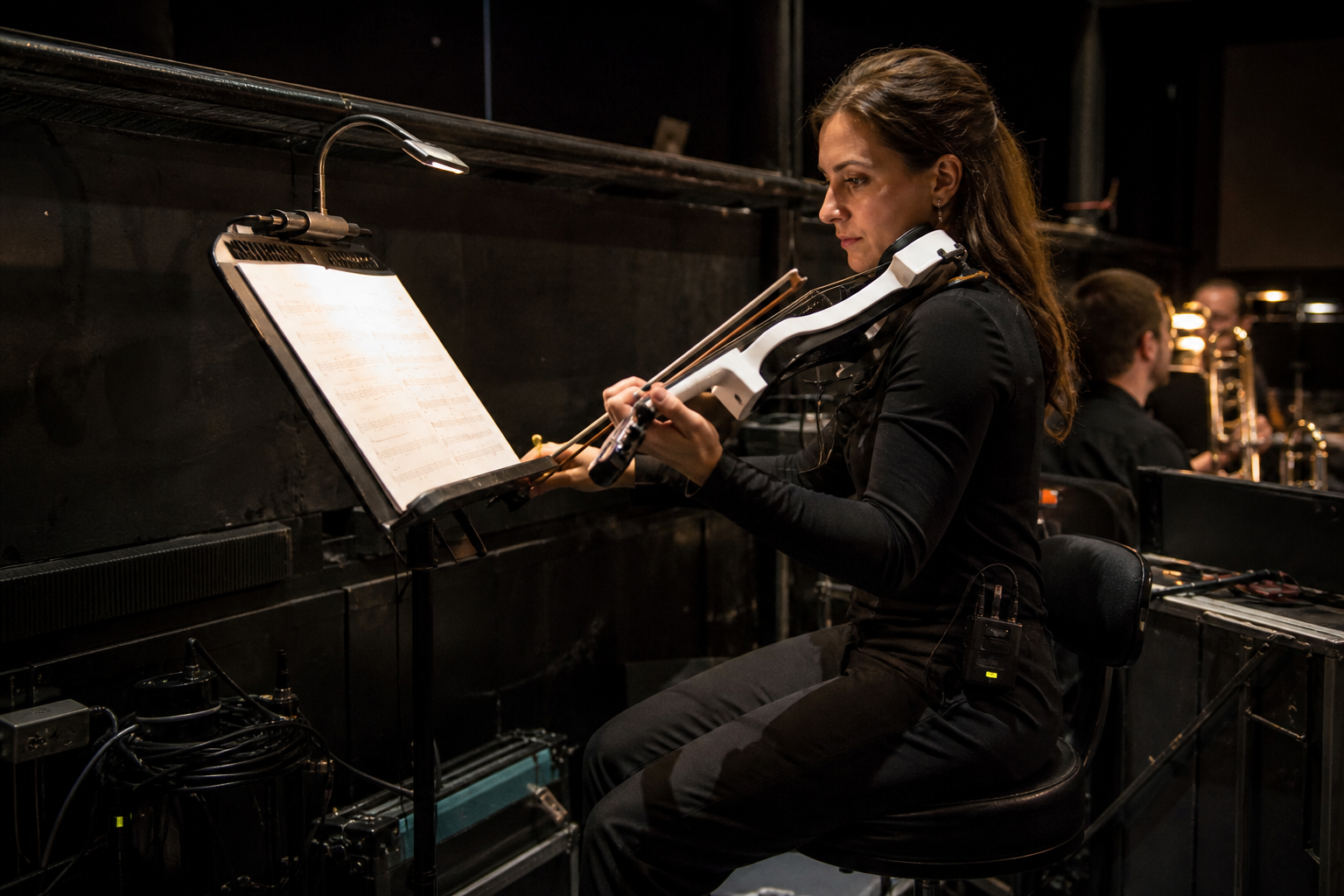
The right stand depends on whether you read printed charts, set lists, medleys, ceremony cues, or theater books as part of your actual performance workflow. This is not about classroom practice. It is about live electric violin work where the stand has to stay readable, stable, and quick to deploy. If you mainly read from a tablet, pair this guide with my roundup of tablet mounts for electric violinists on stage. If dark ballrooms and pits are the real problem, open my guide to music stand lights too.
My performer rule: if I have to think about whether the stand will hold the chart, I am already wasting focus that belongs in the show.
Which music stands are worth buying right now?
I kept this list focused on stand types that make sense for a world-class electric violin performer and content creator: full desk visibility, repeatable height adjustment, sensible carry behavior, and enough stability for weddings, pits, rehearsals, and outdoor sets. I care less about ultra-cheap practice stands and more about tools that still feel professional after months of real load-ins.
| Product | Best for | Why Tanya would use it | Watch out for | Links |
|---|---|---|---|---|
| K&M 11870 Orchestra Music Stand | Most electric violinists who want one serious all-around stand | I trust it because the quick-release desk, 25.59 to 59.06 inch height range, 19.29 x 13.39 inch desk, and 6.173 lb weight land in a very practical middle ground. | It is more of a real orchestra stand than a tiny backup stand, so buy it for visible charts and repeatability rather than minimum size. | Official · Amazon |
| Manhasset Model 52 Voyager | Players who want the most familiar concert-desk feel in a portable design | I like it because the 20 x 12.5 inch desk, 2.25 inch ledge, 26 to 48 inch ledge height, and twist-lock assembly feel like a touring version of the classic orchestra stand lane. | It stores in two main pieces rather than folding flat, and the tote bag is sold separately. | Official · Amazon |
| Peak SMS-40 Collapsible Music Stand | Mobile wedding and event performers who want lower carry weight and an included bag | I would use it when speed matters because Peak pairs a lightweight aluminum frame, 47 inch desk height, 3.7 lb weight, quick clamps, and a carry bag in one simple package. | It is a portability-first buy, so it gives you less of the planted orchestra-stand feel than the heavier desk models. | Official · Amazon |
| Hercules BS418B PLUS | Pit work, seated performance setups, and mobile gigs that still need a real folding desk | I respect it because the perforated aluminum desk, page retainers, one-hand grip, 24 to 45.3 inch height range, and 26.8 x 5.1 x 8.5 inch folded size all point toward practical live reading. | The maximum height is lower than the tallest options here, so it is strongest when the viewing position is not especially high. | Official · Amazon |
| On-Stage SM7711B Orchestra Music Stand | Pits, studios, and stationary rehearsal rooms that want full desk support and stability | I would use it when I want the 12.5 x 20 inch aluminum bookplate, heavy-duty steel shaft and base, 26 to 48 inch height range, and knob-free clutch to stay planted in one room. | It is not the stand I want for constant stair carries and fast solo load-ins. | Official · Amazon |
| RATstands Jazz Stand Pro | Premium touring setups that want a clean fold-flat stand with taller range | I would move here when I want the 483 to 1581 mm height range, flat-fold travel shape, quiet polymer tray, friction locks, and a more polished touring feel. | It costs more, and RAT warns that the small grub screws may need occasional tightening over time. | Official · Amazon |
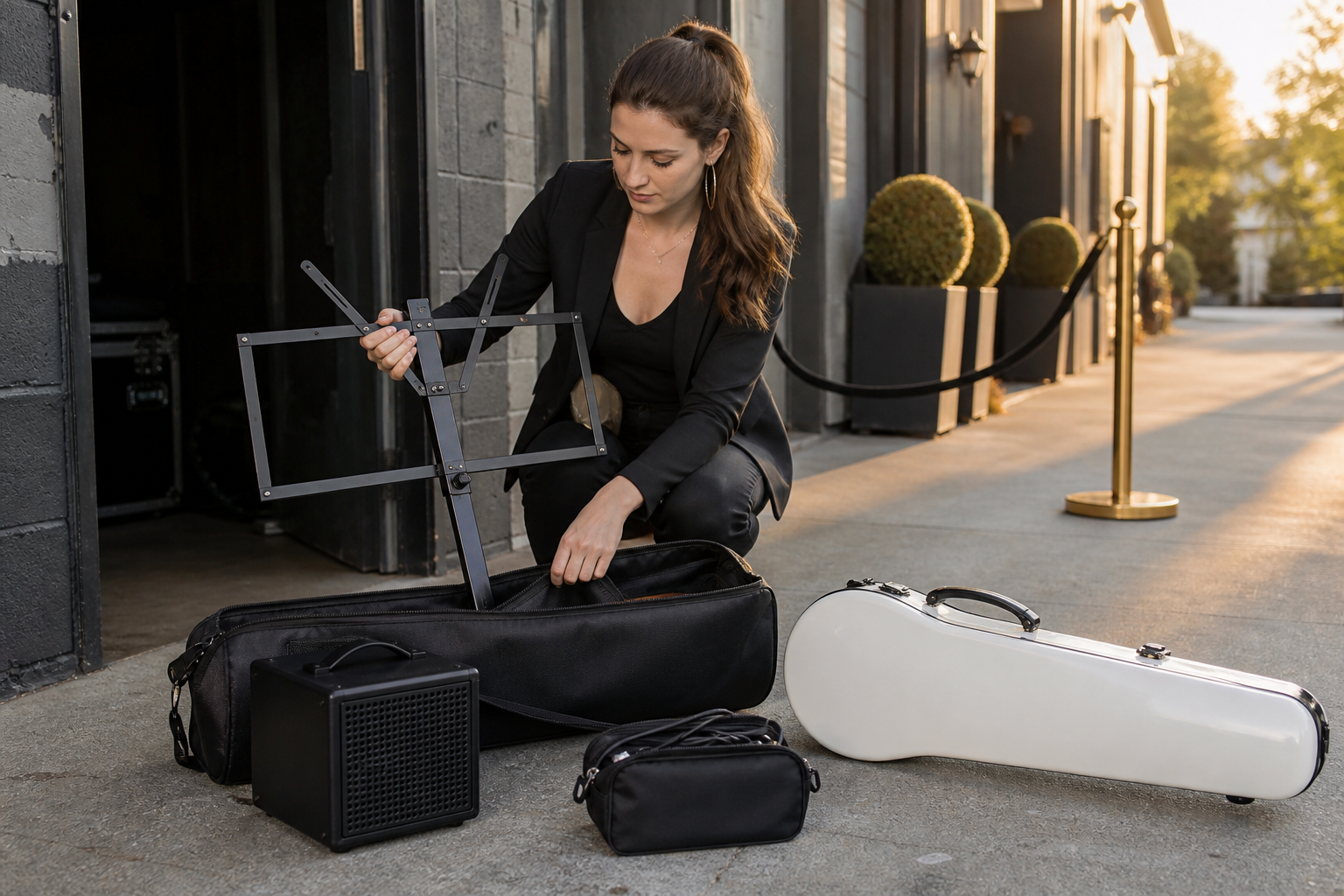
Why is the K&M 11870 my best overall pick?
The K&M 11870 is my best overall pick because it solves the central problem better than most rivals: you get a real desk for printed charts without carrying a stand that feels rooted to one room forever. K&M lists a quick-release lock, a three-piece folding design, a 25.79 x 3.94 x 3.94 inch folded size, a 19.29 x 13.39 inch desk, and a weight just above six pounds. That is a strong balance for electric violinists who move between ceremonies, private events, rehearsals, and content prep without wanting a floppy stand.
Should you buy the K&M 11870 before the Manhasset Voyager?
Yes, if your gigs mix standing sets, mobile travel, and enough printed music to justify a real desk. Tanya Strings would buy the K&M first when she needs one stand to cover the broadest number of professional situations without pretending every show is either a symphony chair or a tiny backup bag job.
- Pros: strong all-around height range, real desk surface, fast quick-release workflow, and a folded size that still behaves well in cars and gear bags.
- Cons: not the lightest option here and still more stand than some phone-and-iPad-first artists need.
See the K&M 11870 · Check K&M 11870 on Amazon
When does the Manhasset Voyager win instead?
The Manhasset Voyager wins when you want a more traditional concert-stand feel and you are happy to travel with a two-piece setup rather than the flattest possible package. Its desk matches the familiar Symphony Stand size, and the ledge-to-floor height range of 26 to 48 inches makes good sense for seated or standing reading. Tanya Strings would favor it for players who know they like that classic desk behavior and do not need the most compact folded profile first.
- Pros: classic desk feel, strong score support, sensible height, and a more orchestral reading experience.
- Cons: less compact than flat-fold designs and the travel bag is extra.
See the Manhasset Voyager · Check Voyager on Amazon
Which folding stands make the most sense for travel-heavy gigs?
Folding stands matter when the music stand is part of a wider travel problem: case, pedals, cables, lights, spare batteries, and content gear all compete for the same carry budget. If that sounds familiar, my guide to backpacks and gear bags is worth reading alongside this one.
Is the Peak SMS-40 the best value portable stand?
Peak's SMS-40 is the value portable stand I would watch first when the brief is simple: keep the carry light, keep setup quick, and do not overspend before the rest of the stage rig is sorted. Peak says the aluminum-frame stand reaches 47 inches to the bottom of the desk, weighs 3.7 pounds, and ships with a carry bag. That is exactly the kind of practical spec mix that helps solo electric violin event work feel calmer.
- Pros: low carry weight, included bag, fast clamps, and sensible value for mobile gigs.
- Cons: less planted feel than heavier orchestra-stand designs and less desk gravitas for thicker books.
See the Peak SMS-40 · Check SMS-40 on Amazon
When does the Hercules BS418B PLUS beat lighter options?
The Hercules BS418B PLUS is smarter when you still want folding portability but care more about desk control, page retainers, and seated positioning than about shaving every possible ounce. Hercules lists a perforated folding desk, one-hand height adjustment, a 24 to 45.3 inch height span, and a folded size of 26.8 x 5.1 x 8.5 inches. Tanya Strings would keep it close for theater-style work, lower reading positions, and hybrid gigs where the stand has to behave well in tighter spaces.
- Pros: useful page retention, one-hand adjustment, foldable desk, and strong lower-position usability.
- Cons: lower maximum height than the taller touring options and not the lightest carry here.
See the Hercules BS418B PLUS · Check BS418B PLUS on Amazon
Why would I pay more for the RATstands Jazz Stand Pro?
The RATstands Jazz Stand Pro is the premium travel answer when you want the stand to fold flat, move cleanly, and feel more refined than basic collapsible options. RATstands says the vertical stem pushes the height range to 483 to 1581 mm, the polymer tray stays quieter than ringing metal, and the stand adds a rubber front foot for extra stability. Tanya Strings would buy it when the stand is part of a polished touring or branded-event setup rather than a temporary low-cost fix.
- Pros: tall range, flat-fold profile, quieter tray material, and polished premium feel.
- Cons: real price step-up and occasional screw-tightening maintenance is part of ownership.
See the RATstands Jazz Stand Pro · Check Jazz Stand Pro on Amazon
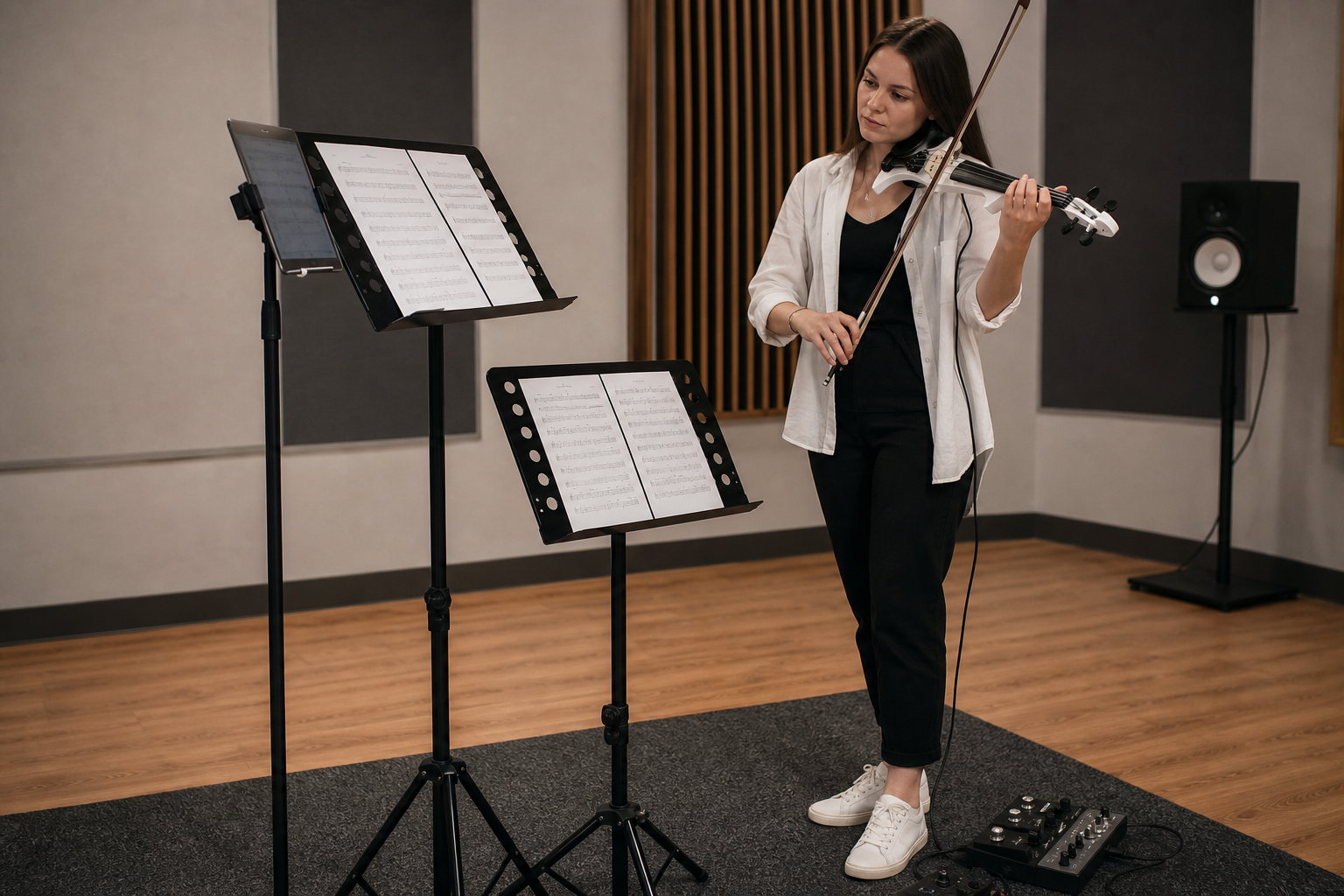
When is the On-Stage SM7711B the smarter stationary buy?
The On-Stage SM7711B is the smarter buy when your stand mostly lives in one room, one pit, or one recurring rehearsal setup and you want strong desk support more than travel elegance. On-Stage describes a 12.5 x 20 inch aluminum bookplate, steel shaft and base, a 26 to 48 inch height range, and a knob-free clutch that holds the viewing angle in place. Tanya Strings would use it when charts are heavy, the location is predictable, and constant carry weight is not the main problem.
- Pros: stable full desk, steel support, easy angle setting, and good sense for pits and studios.
- Cons: less appealing for frequent load-ins, stairs, and fast event turnover.
See the On-Stage SM7711B · Check SM7711B on Amazon
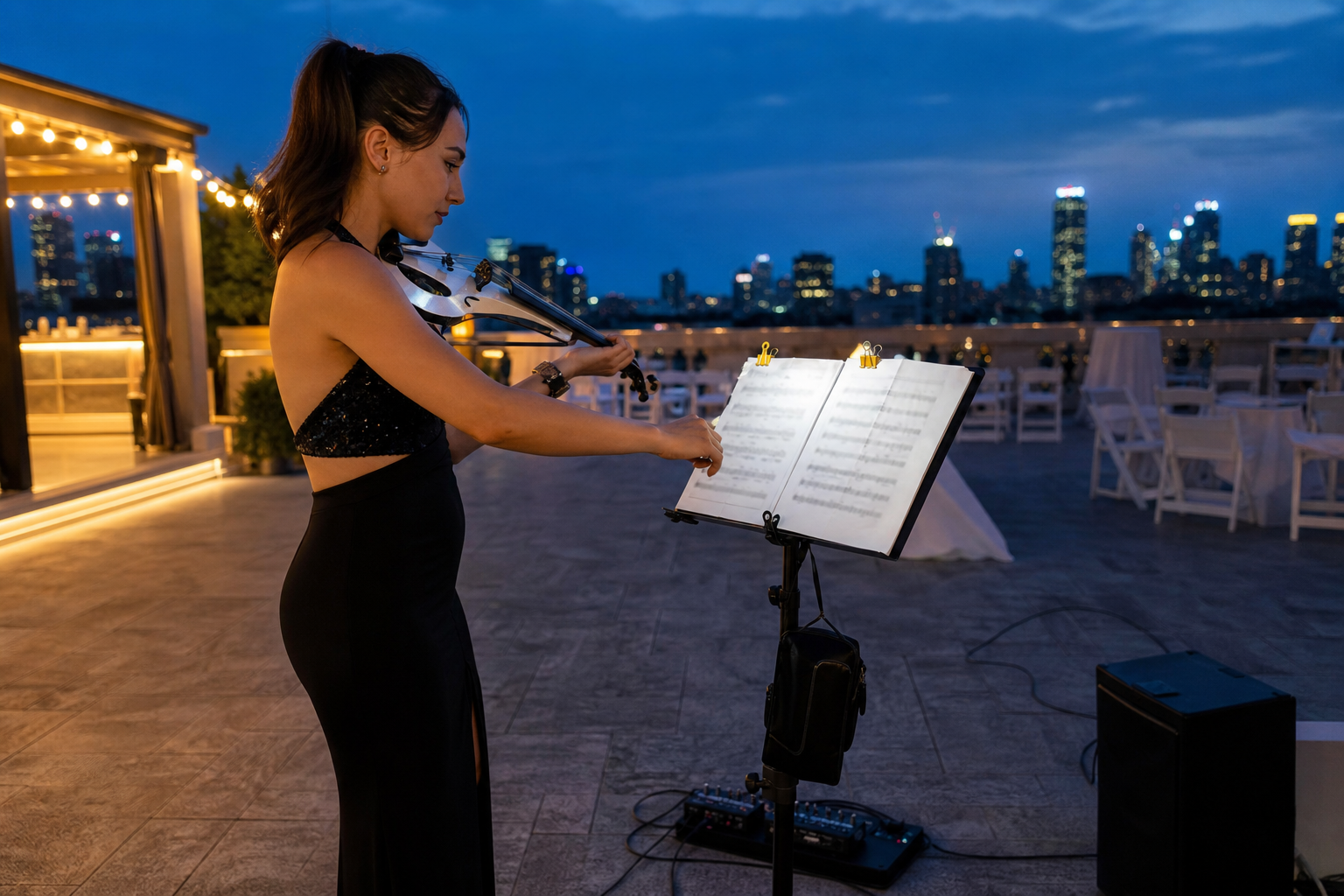
How should electric violinists choose a stand for weddings, theater pits, and outdoor sets?
Choose the stand around the exact job, not around abstract catalog pride. Tanya Strings wants the stand that removes friction from real performance days, whether that means a flatter carry shape, a larger desk, or a lower seated position. If the event kit still feels overloaded, trim the rest of the setup with smarter choices around cases, laptop control, and tripods.
My buying checklist:
- Start with the repertoire: thick printed books need more desk than a short ceremony chart.
- Check seated and standing height honestly: pit work and cocktail-hour work do not ask the same thing from the stand.
- Respect the folded shape: a stand that fits badly with your case and pedal bag becomes annoying fast.
- Plan for page control: outdoor work rewards page retainers, clips, and a clear wind strategy.
- Watch the total carry lane: every extra pound matters once the violin, speaker, and content gear are already in the car.
- Buy for repeatability: the right stand is the one you can set up quickly again next weekend without irritation.
What mistakes make a music stand harder to trust live?
Most music-stand frustration starts before the stand ever touches the stage. The wrong pick usually comes from treating the stand like a generic accessory instead of part of the performance system.
- Buying only by minimum price: cheap wire stands usually lose the argument once the charts get heavier or the room gets busier.
- Ignoring the folded package: awkward travel shape creates as much friction as bad desk design.
- Forgetting the viewing angle: neck strain and page glare show up quickly in long sets.
- Skipping the wind plan: outdoor elegance disappears the moment the pages start moving.
- Using a one-room stand for every mobile gig: stability is good, but dead weight is still dead weight when you are loading in alone.
FAQ
What is the best music stand for most electric violinists?
For most working electric violinists, the K&M 11870 is the best starting point because it gives you a proper desk, useful height, and a folded shape that still makes sense for mobile work.
Is a folding stand stable enough for weddings and outdoor sets?
Yes, if the desk is well built and the legs feel planted. Tanya Strings would still add page clips or retainers for any outdoor job where wind is even mildly possible.
Should electric violinists buy a full orchestra desk or a smaller portable stand?
Buy the full desk when you regularly read printed charts, medleys, or pit books. Buy the smaller portable option when speed, bag space, and lighter carry matter more than maximum desk area.
What matters more on stage: stand weight, desk size, or height?
Desk size and viewing angle come first because they affect whether you can actually read and perform comfortably. After that, weight matters because the stand still has to survive the whole travel day.