Tanya Strings · 27 November 2026
Violin News: Lamsma, Philippens and Dego
Today’s violin news offers three sharply different ways to hold a room. In Singapore, Simone Lamsma takes John Adams’s Violin Concerto into an orchestral programme whose electronic synthesisers extend the palette. In Amerongen, Rosanne Philippens puts stories and improvisations beside solo playing in a church setting. In Cesena, Francesca Dego brings Brahms’s Violin Concerto to a full symphonic stage before repeating the programme in Parma tomorrow. Tanya Strings’ performer take is simple: these are not interchangeable dates. Each makes a clear promise about sound, scale and the relationship between artist and audience.
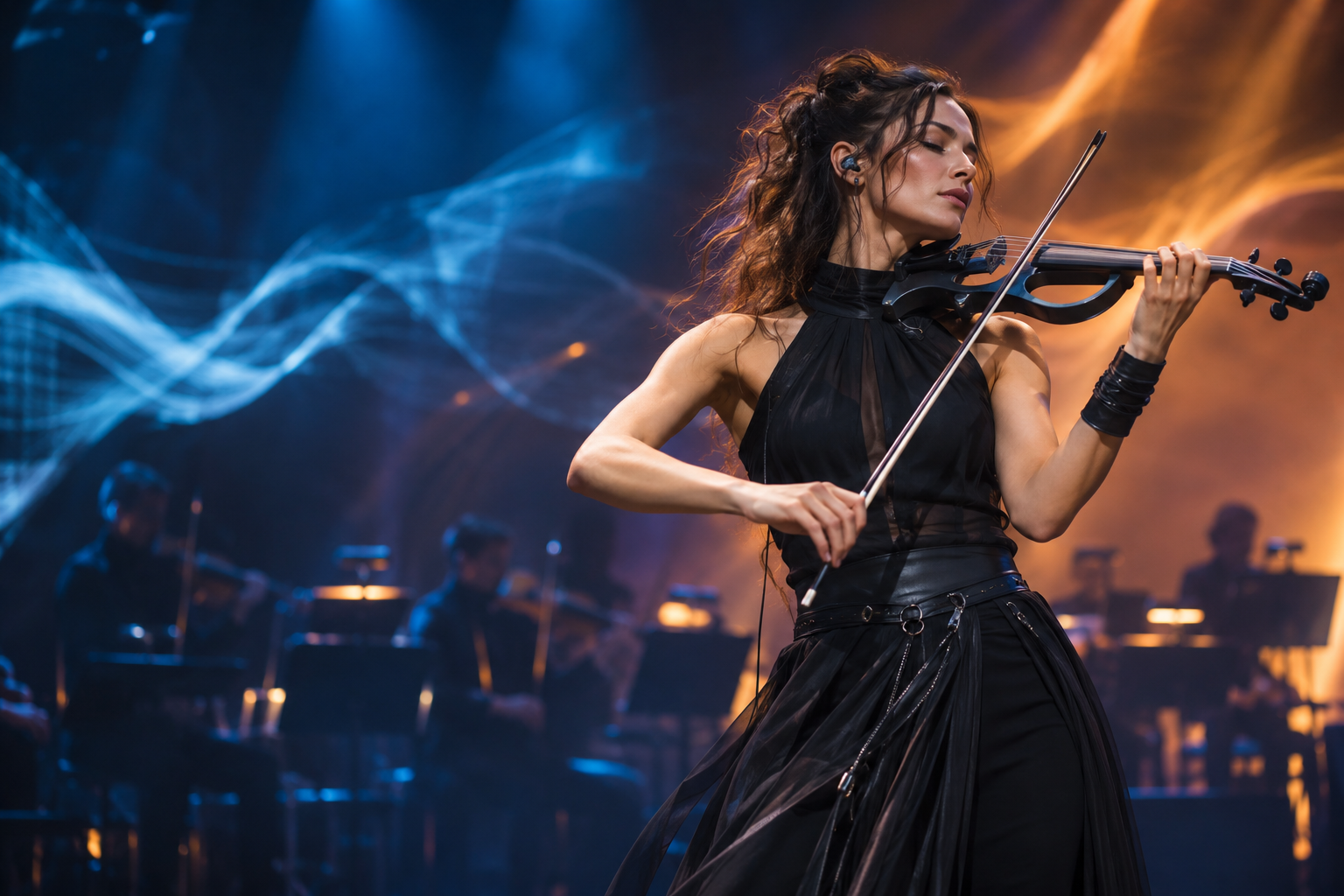
Why is Simone Lamsma’s John Adams concerto a useful signal for amplified-stage thinking?
The Singapore Symphony Orchestra’s official announcement lists Lamsma with Hannu Lintu for John Adams’s Violin Concerto at Victoria Concert Hall on 27 and 28 November. The programme places it alongside Copland’s Appalachian Spring and Schumann’s Fourth Symphony. The orchestra describes the Adams work as accompanied by electronic synthesisers, an important detail because it asks the solo violin to stay specific inside a broader colour field.
For electric violinists, that does not mean copying orchestral electronics. It means respecting the same job: decide what the violin’s core sound is before delay, pads or loops arrive. A strong direct sound, disciplined gain and a tested monitor mix let added texture feel intentional. For planners, the lesson is equally practical. Complex sound can still feel elegant when the programme gives the audience a route into it.
What should a performer listen for?
- Whether the violin’s attacks remain articulate against sustained electronic colour.
- How orchestral density changes the soloist’s place in the mix.
- Where contrast in the programme gives the audience a reset.
Tanya’s performer take: technology earns its place when it enlarges the musical sentence without blurring the player’s identity.
What makes Rosanne Philippens’ Amerongen recital feel personal?
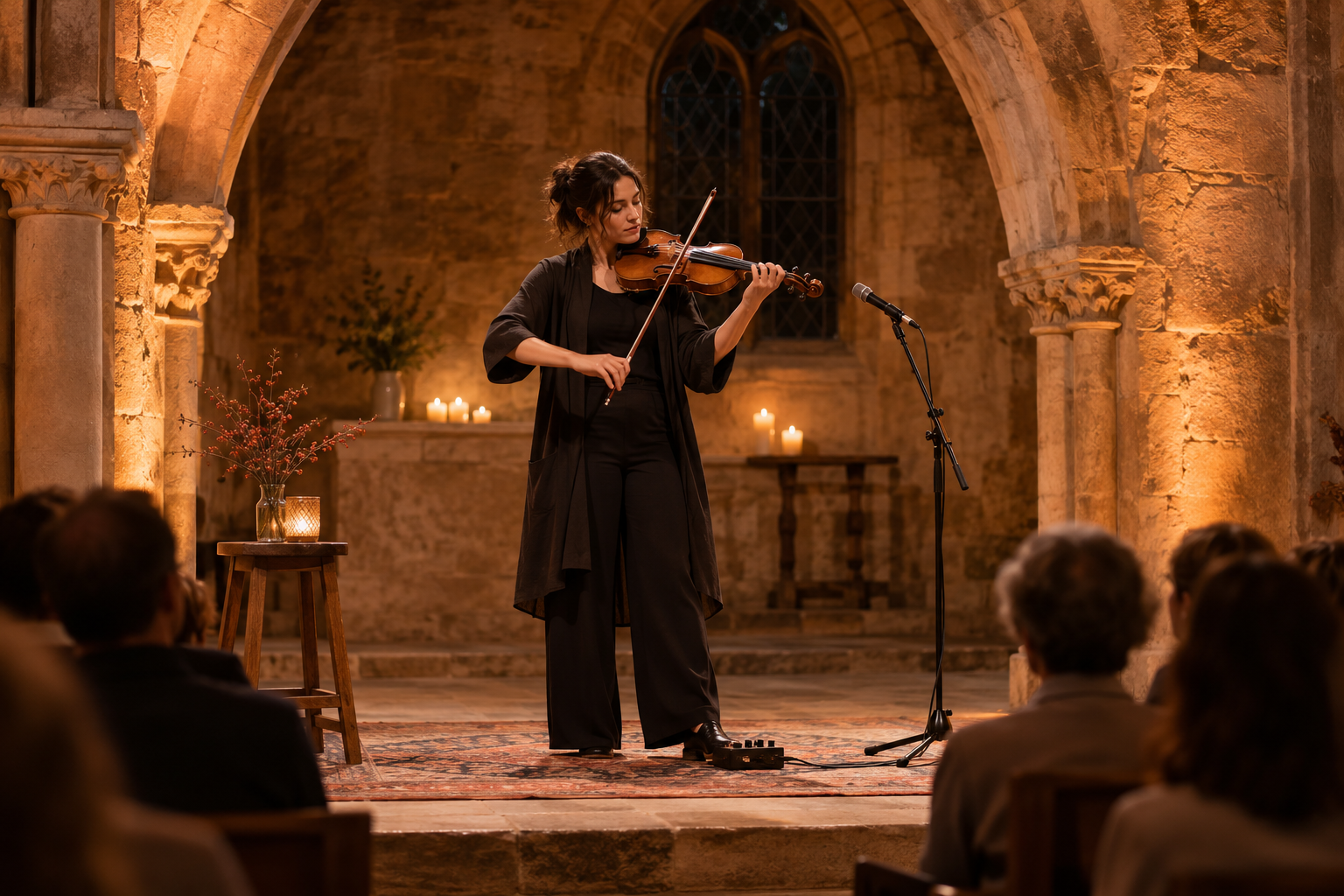
Philippens’ official calendar lists a 27 November solo “Insight” appearance at the Andrieskerk in Amerongen. The listing says she will play her Stradivarius from different corners of the church, with stories and improvisations between the music. This is a compact but potent production idea: the space, spoken voice and acoustic instrument become part of the programme rather than background information.
Improvisation changes the contract with a listener. It leaves room for risk, and that can make a familiar instrument feel newly present. A crossover performer can use the same principle on an electric set through a short live introduction, an improvised transition, or a loop built visibly from one phrase. The point is not to add chatter. It is to create a genuine point of contact and let the audience understand why a moment is happening now.
How does Francesca Dego’s Brahms date show the value of repertoire continuity?
Francesca Dego’s official site lists Brahms’s Violin Concerto with the Filarmonica Arturo Toscanini and conductor Stepan Armasar at Teatro Bonci in Cesena on 27 November, followed by a Parma performance on 28 November. Two close dates with the same large concerto are more than calendar efficiency. They give soloist and ensemble a chance to deepen a demanding long-form conversation in front of different audiences.
Brahms rewards patience: its scale asks the player to make a long line speak while still answering the orchestra in the moment. Event teams can borrow this thinking. When a show travels or repeats, protect the musical centre while adapting the room, soundcheck and visual framing. A repeat audience should receive a living performance, not a copied file.
What is worth taking into the next live set?
- Build one unmistakable musical centre before adding supporting material.
- Keep a repeatable technical baseline, then leave room to react to the venue.
- Make transitions, lighting and onstage movement serve the repertoire’s arc.
These Singapore, Amerongen and Cesena dates point to one current truth: live violin is strongest when format has purpose. Tanya Strings approaches every stage as a world-class electric violin performer and content creator, where music, image and audience attention have to meet at the same time. For fans, performers and bookers, that is the useful news to carry forward.