Violin News: Roan Ma, Forestier and Casta
Today’s violin news is about designing a complete live experience, not staying inside one format. In Toronto, Roan Ma has premiered a new piece for solo violin and audio playback. In Duisburg, Jacques Forestier is meeting Dvořák’s Violin Concerto with the city’s philharmonic orchestra on 25 and 26 November. Rome then looks toward a 29 November electric-violin event by Andrea Casta, built for an immersive room of projection and spatial sound. Tanya Strings’ performer take is direct: every strong violin appearance needs a clear musical centre, but the room, sound system and audience journey deserve equal artistic attention.
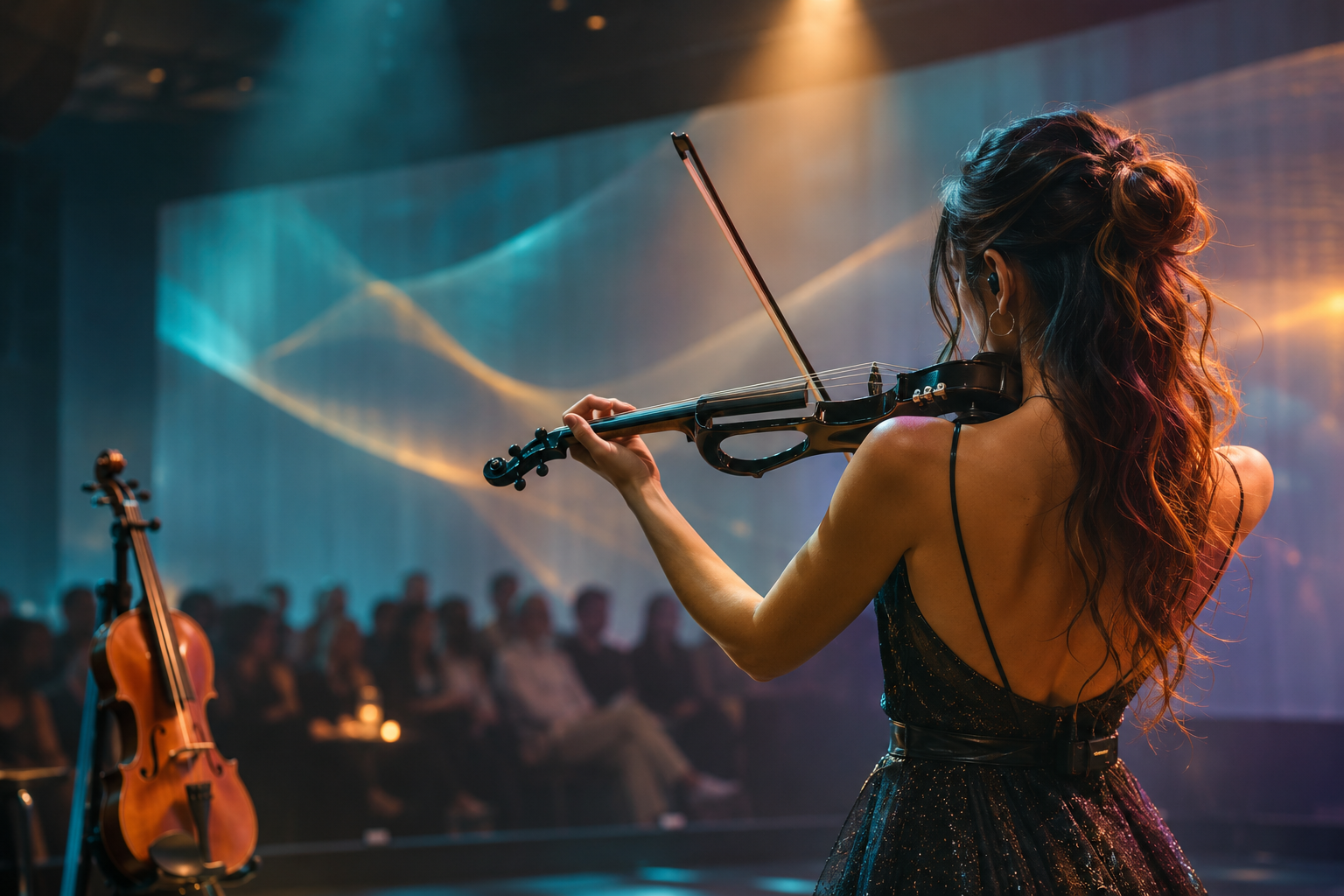
What does a violin-and-playback premiere make possible?
Composer Parisa Sabet’s event note identifies Where Traces Remain as a work for solo violin and audio playback, commissioned by Music Toronto for violinist Roan Ma and premiered on 24 November at the Jane Mallett Theatre. The recorded layer draws on material by Ma and tar player Arman Nikaeen, while Ma performs the live violin part. Music Toronto’s own listing confirms the pre-concert slot, placing the performance before Illia Ovcharenko’s piano recital.
That framing is useful because playback does not have to mean a violinist pressing play and hoping for the best. It can make memory, timbre and musical identity part of the instrumental design. A brief pre-concert performance also asks the artist to establish its world fast: the first sound, physical setup and transition offstage all count.
What should a performer prepare beyond the notes?
- Carry a redundant playback path and decide who owns each cue.
- Rehearse the first ten seconds with the exact monitoring available in the room.
- Give the presenter a concise programme note so listeners understand why live and recorded sound meet.
Tanya’s performer take: when technology has a musical reason, it can make a compact set feel bigger than its duration.
Why does Forestier’s Dvořák date matter this week?
The Duisburg Philharmonic programme puts Canadian violinist Jacques Forestier in Dvořák’s Violin Concerto on 25 and 26 November, conducted by Ariane Matiakh at the Philharmonie Mercatorhalle. The programme surrounds the concerto with Lyadov’s Kikimora and excerpts from Smetana’s Má vlast. The orchestra notes that Forestier shared first prize at the 2024 Joseph Joachim Violin Competition; the competition’s official site also lists these concerts as part of its prizewinner series.
A concerto appearance is never just a soloist’s showcase. Dvořák demands rhythmic buoyancy, long narrative lines and alert exchange with an orchestra that can turn a fraction of timing into a different colour. For a young artist, repeating the programme on consecutive nights is equally valuable: the second performance turns observation from the first into a more relaxed, audience-facing decision.
How can event planners use that lesson?
Build a short production conversation around the soloist’s arrival, rehearsal time and visual sightlines. Acoustic violin may not need a pedalboard, yet the player still needs a dependable stand position, quiet backstage route and enough time to hear the hall before an entrance. Those details protect the musical risk audiences have come to hear.
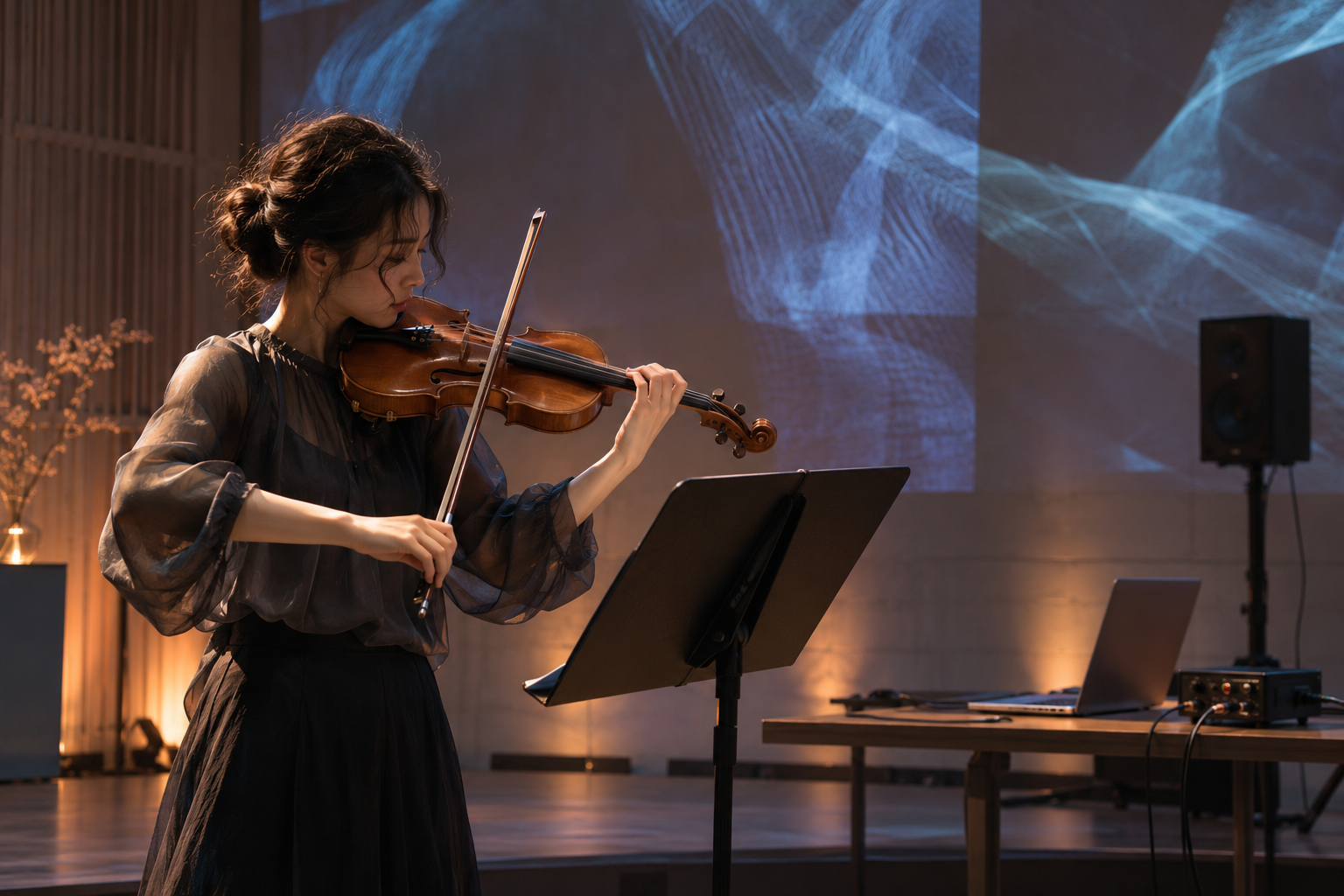
How is Andrea Casta changing the electric-violin room?
AVnode’s programme page lists HyperMedia x Andrea Casta for 29 November at Rome’s MAM – Media Art Museum. The event description places Casta and his electric violin inside the museum’s Immersive Room, using a central 360-degree setup, 27 projectors and multidirectional sound. It describes a live set that works with the exhibition’s sound design, new electronic material and real-time improvisation; Casta’s luminous bow is part of the physical visual language.
The headline here is not gear for gear’s sake. This is a production concept in which bow gesture, video scale and sound placement carry one promise to the audience. It is a useful benchmark for performers who blend electric violin with content creation: the visual layer should reveal a musical choice, not distract from one.
What can music fans watch for?
Watch whether the staging changes how you listen. Can you still follow the phrasing when the projections move? Does a cue in the light explain an arrival in the music? Can the performer make a huge technical environment feel personal? Tanya Strings works from that same world-class performer-and-creator standard: bold production earns its place when it makes the violin’s voice more immediate.