Violin News: Ito, Blue Violin and Li
Today’s violin news is about the many ways a performer can reach a room. Japan’s Manami Ito has been recognised by Guinness World Records as the first violinist with a full prosthetic arm. In Albuquerque, electric-violin artist Blue Violin brings an ’80s holiday production built around band, choir and projection mapping to the stage tonight. In Szczecin, Jinzhu Li begins a Wieniawski Competition laureates’ tour with Sibelius’s Violin Concerto. Tanya Strings’ direct performer view: technique matters, but the lasting connection comes from designing a complete experience: how the body moves, how the sound travels, and what an audience remembers after the final note.
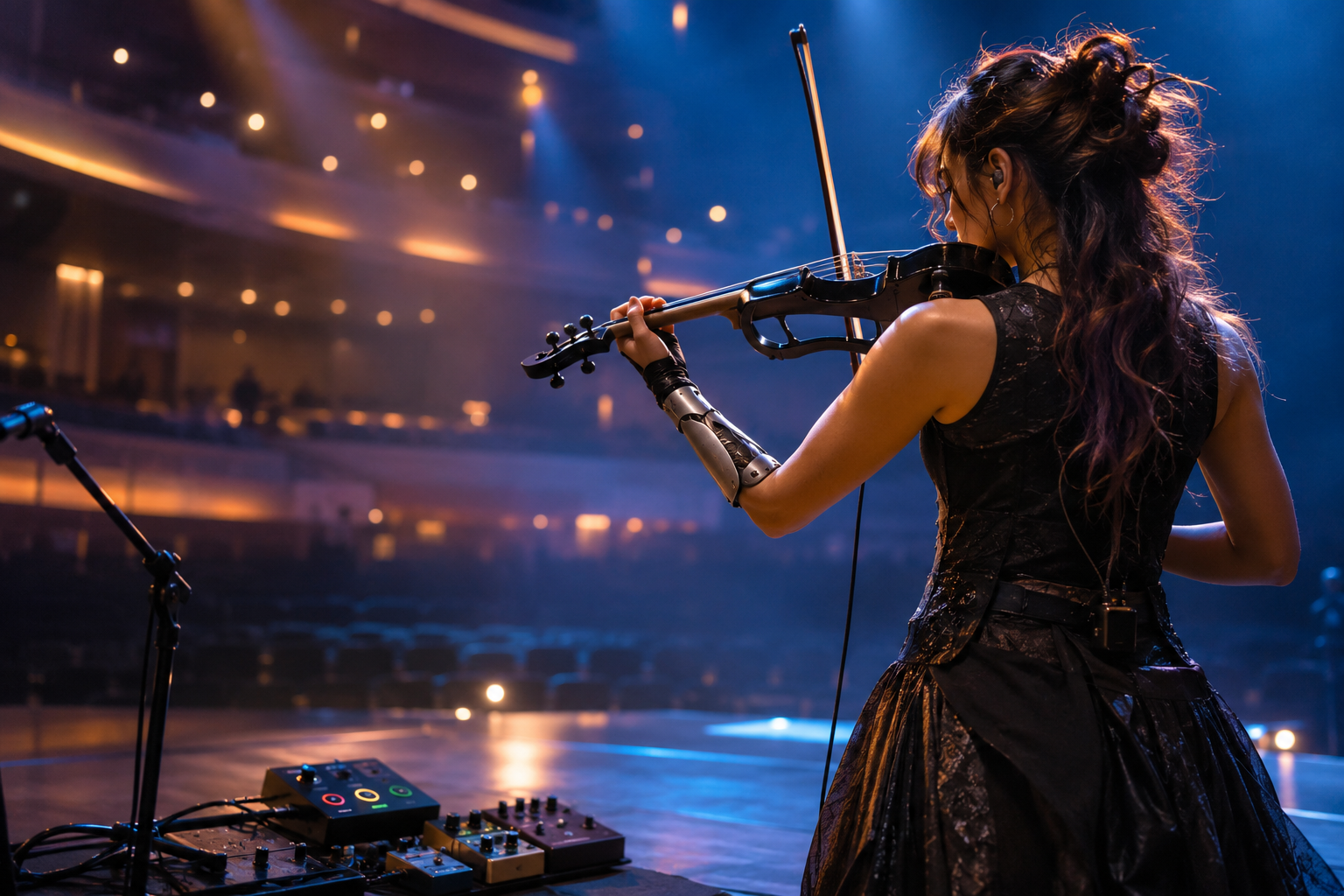
What does Manami Ito’s Guinness recognition tell performers?
Guinness World Records reported on 9 November that Manami Ito appears in its 2027 edition as the first violinist with a full prosthetic arm. Ito lost her right arm after a 2004 traffic accident, then returned to the violin using a custom artificial limb. Guinness says she claimed the record after performing at a medical conference in Kobe in 2012.
Ito’s path says something performers know: every body, instrument and setup is specific. A reliable routine comes from workable positions, repeatable motions and a supportive sound chain.
How can a musician turn constraints into clearer stage design?
Start by removing avoidable friction. Put essential pedals within one comfortable step, label the few changes that must happen in the dark, and rehearse entrances in the shoes and costume used onstage. When acoustic or electric violin gear is involved, cable angle, strap choice, in-ear mix and bow clearance are musical decisions as much as technical ones. A stage plot should serve the performer’s movement, not demand a movement that makes the music harder.
Tanya’s performer take: a powerful performance is never one-size-fits-all. Build a rig and visual language around what lets you play with freedom, then let the audience meet the music first.
Why is Blue Violin’s Albuquerque show useful electric-violin news?
Blue Violin’s official tour page lists a 20 November stop at Albuquerque’s Bank of America Theatre in the National Hispanic Cultural Center. The project, led by Chris Vuk, frames holiday material and 1980s rock references as a concert production rather than a conventional recital. The local event listing describes a live rock band, choir and cathedral-style projection mapping alongside the violin performances.
This is crossover programming with a clear promise: the violin links familiar songs, visual cues and a live band. For event planners, the lesson is to define the guest feeling in one sentence, then make lighting, pacing and repertoire support it.
- Give the first minute an unmistakable sonic and visual identity.
- Save the largest loop or effect change for a musical turning point, not every chorus.
- Confirm projection, click-track and monitor needs in advance with the venue.
Tanya’s performer take: electric violin is strongest when its sound design has a dramatic job. A well-placed dry line can be as exciting as the widest possible effect.
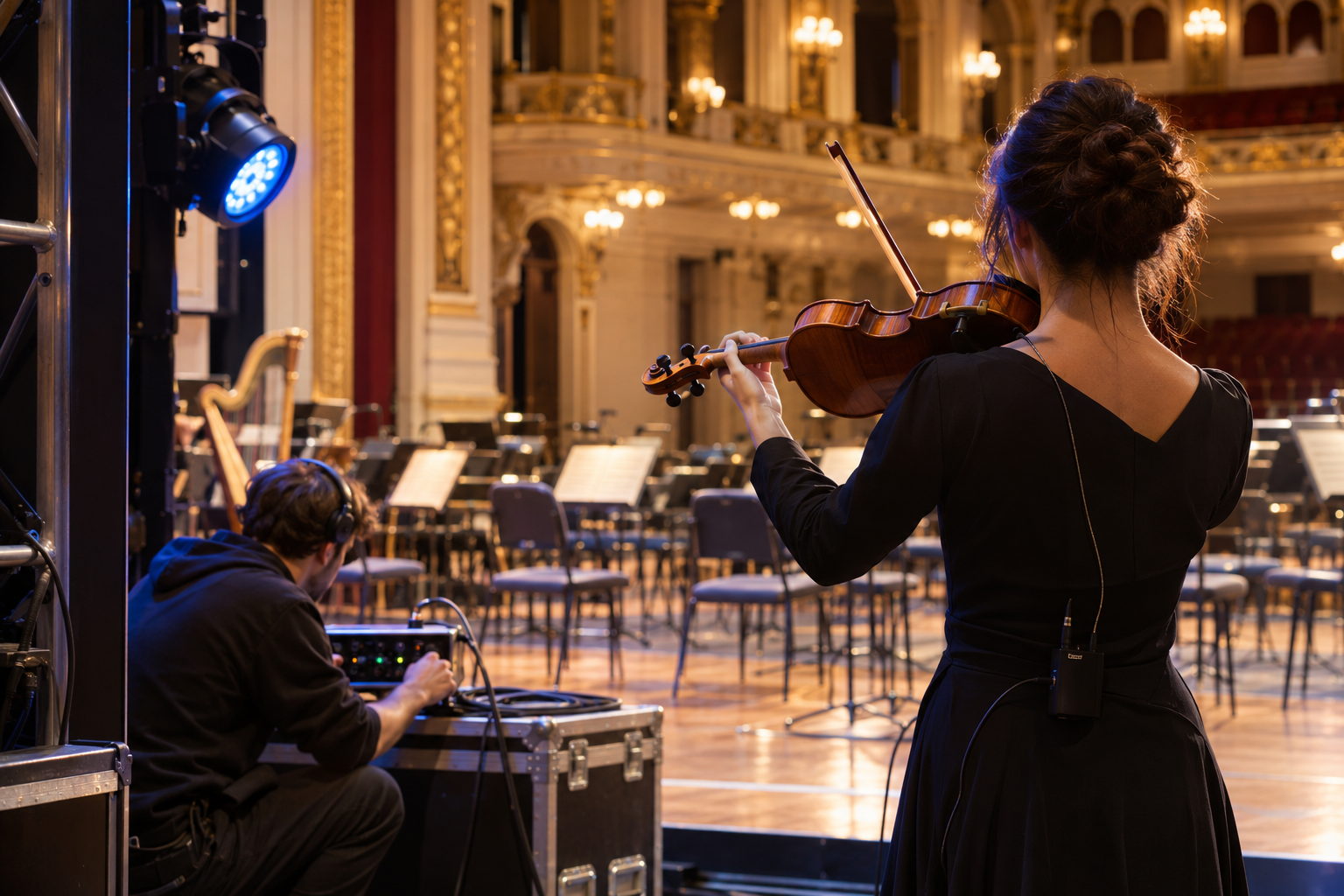
Why does Jinzhu Li’s Szczecin appearance matter after a competition?
The Szczecin Philharmonic announced on 17 November that Jinzhu Li, second-prize winner of the 17th Henryk Wieniawski International Violin Competition, performs on 20 November; winner Bohdan Luts follows on 22 November. The official programme page lists Li with the Szczecin Philharmonic Symphony Orchestra and conductor Przemysław Neumann in Sibelius’s Violin Concerto, alongside the opening half of Smetana’s Má vlast.
A prize is a news moment; the tour makes a musical identity durable. Moving from judged rounds to a public concerto asks for another focus: pacing a long line, sharing space with an orchestra and communicating beyond the result. Viral clips can open a door, but repeated, well-programmed appearances build trust.
What should performers and music fans carry forward?
This week connects resilience, production and repertoire. Ito shows that an individual solution can become a public artistic voice. Blue Violin demonstrates that the electric violin can lead a fully staged popular-music experience. Li’s concert shows the next chapter after competition success: meet a new audience with substantial repertoire. Tanya Strings approaches violin as a complete stage language—world-class playing, sound design, visual control and connection in the room. The common thread is simple: make the performance feel intentional from the first setup decision to the final bow.