Violin News: Xani, Long-Thibaud and Audient
This week’s violin news connects the concert platform with the work around it. Australian electric-violin artist Xani Kolac’s commissioned KOŁACZ is heading to radio after its Melbourne premiere. In Paris, four players have reached the Long-Thibaud final, where one concerto can change a season. Randall Goosby now has exclusive worldwide management with Primo Artists. Audient announced a desktop-interface range with room correction and onboard processing. Tanya Strings’ practical thread: distinctive performance, clear presentation and reliable creator tools now travel together for audiences.
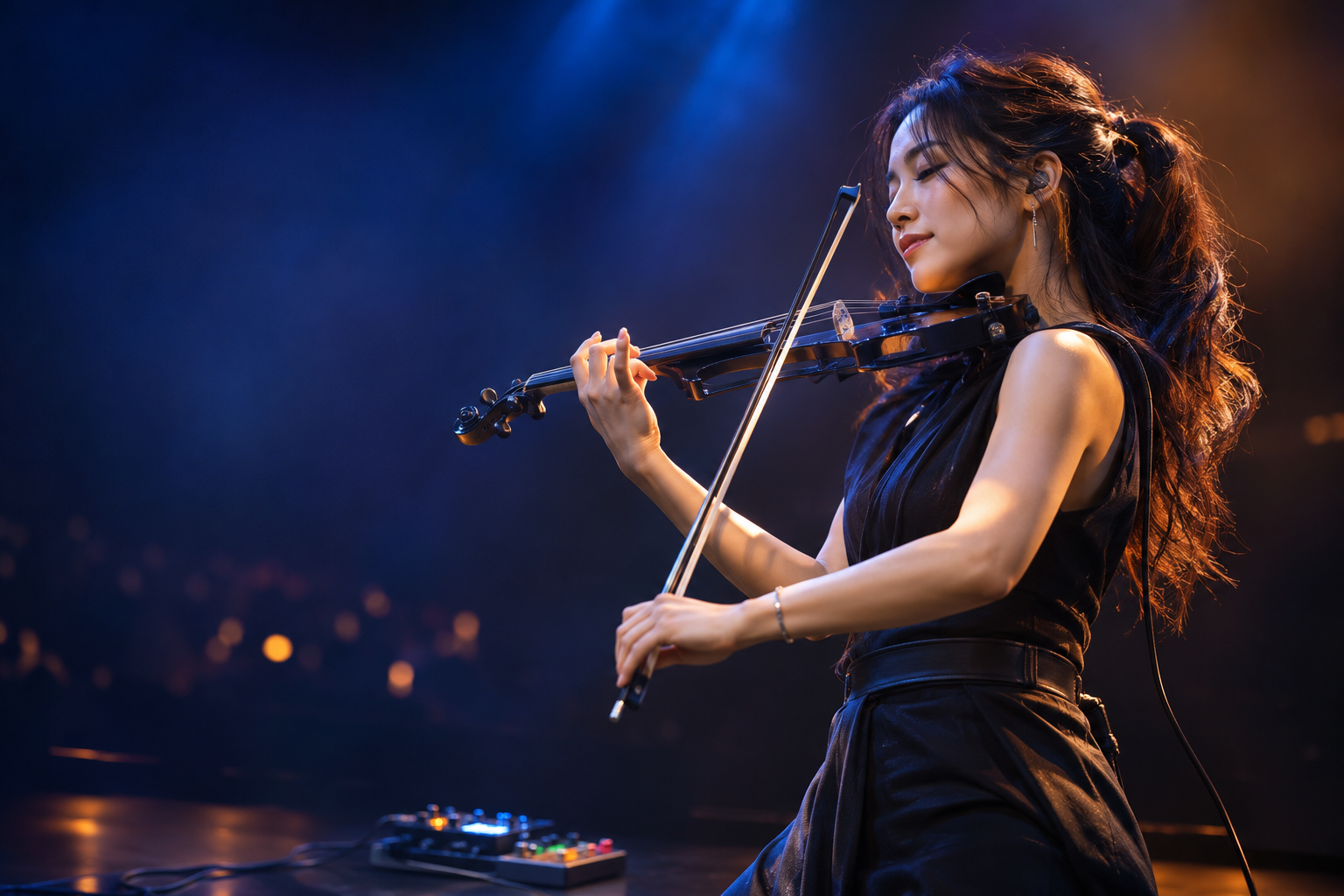
Why is Xani Kolac’s KOŁACZ a useful electric-violin signal?
PBS FM announced on 12 November that it will broadcast Xani Kolac’s commissioned work KOŁACZ in full on 22 November, following its world premiere at the 2026 Melbourne International Jazz Festival. The station describes Kolac as a violinist, composer and leader working across contemporary and improvised music. The piece brings her together with Tuulikki Bartosik, Helen Svoboda and Justin Olsson, and its starting points include language, belonging and movement.
The important point is that electric violin is the centre of a commissioned collaborative work, not a novelty colour. The festival listing places Kolac’s practice between traditional instrumentation and experimental sound worlds.
- Commissioning creates a reason for the audience to pay attention before the first note.
- A clear narrative can guide an experimental sound without explaining every bar.
- A later broadcast gives a live work a second, genuinely useful life.
Tanya’s performer take: build a set around an idea strong enough to survive the move from stage to clip, stream or radio. Gear matters, but the premise is what makes the sound memorable.
What is at stake in the Long-Thibaud final tonight?
The 2026 Long-Thibaud competition is devoted to violin, and its official schedule places the final at the Théâtre des Champs-Élysées in Paris on 14 November. After semi-finals with recital repertoire, four finalists perform with the Orchestra of the Republican Guard under Bastien Stil. They choose from major concertos by Lalo, Brahms, Tchaikovsky, Beethoven, Mendelssohn, Prokofiev, Sibelius and Shostakovich; results are scheduled for 8 p.m.
The Violin Channel lists the finalists as Stefania Pospekhina, Francesco Papa, Jenny Hyeonjeong Lee and Marika Konishi. A final with orchestra is not simply a bigger version of the previous round. It tests pacing, entrances, leadership and how a performer communicates through a large musical machine under real pressure.
What can an electric violin performer borrow from concerto preparation?
Make your first thirty seconds unmistakable. In an amplified set, begin cleanly before effects expand, then rehearse every hand-off to band, playback, lighting or loop. Visible technical confidence reads as preparation.
Why does Randall Goosby’s management news matter beyond business?
On 11 November, Primo Artists said it had taken exclusive worldwide management of Randall Goosby, replacing the previous joint arrangement with HarrisonParrott. Its announcement points to forthcoming orchestral debuts, recitals with pianist Zhu Wang and work with the Renaissance String Quartet.
The news reminds performers to keep their public identity coherent as their territory grows. Clear representation helps event planners; artists should keep current live video, an honest technical rider and a repertoire list that reflects the show people can book.
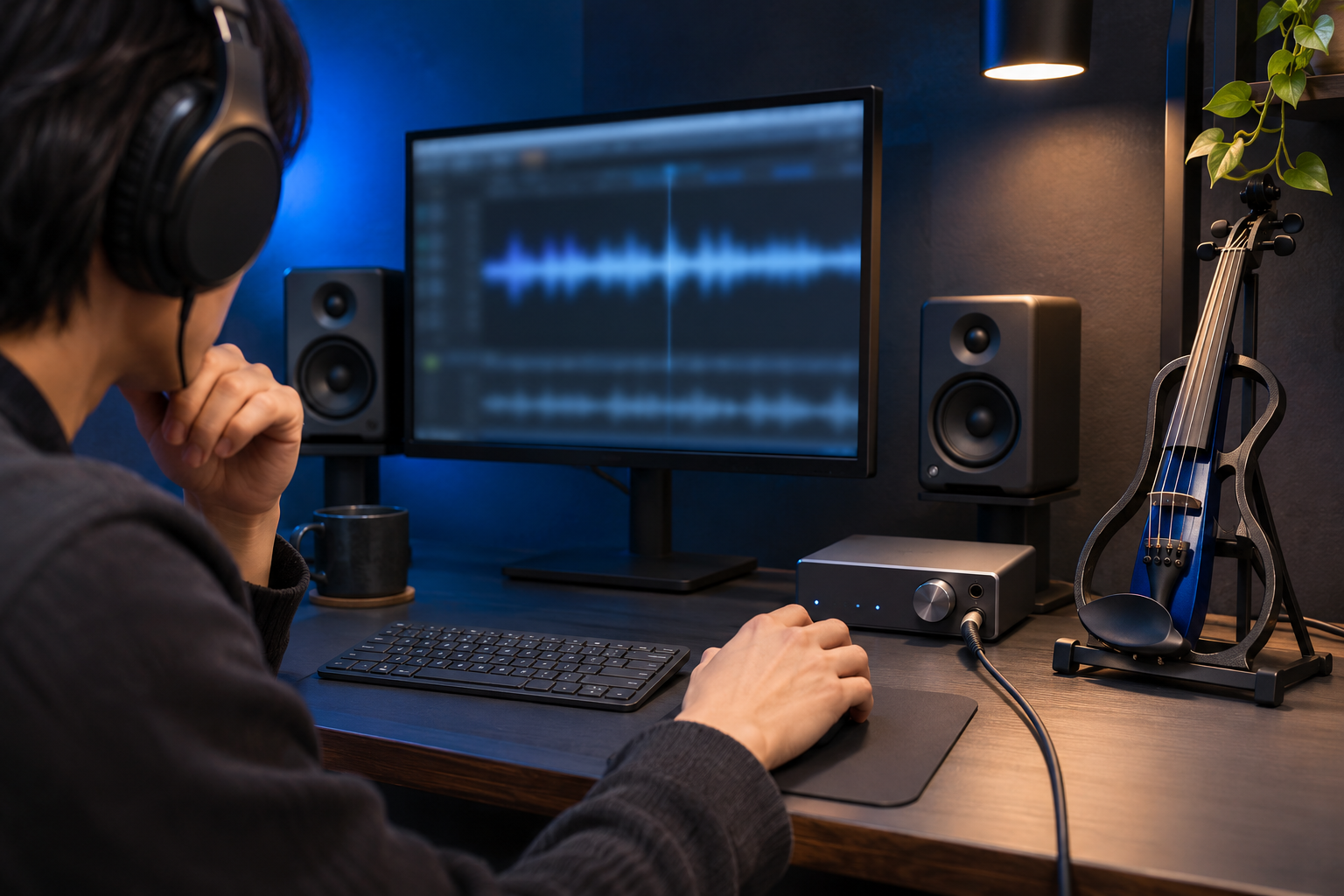
Could Audient’s new iD range help music creators hear decisions more clearly?
Audient’s 12 November launch introduces iD1, iD2, iD2+ and iD4+ MK3 interfaces. The company says every model combines console-style preamps, USB-C bus power, 32-bit conversion, onboard DSP effects and RoomTune monitor correction. The iD2+ and iD4+ include the RoomTune reference microphone; it is optional for smaller models.
This is not a call to replace a working chain. It is a marker of where creator tools are heading: monitoring decisions can increasingly be addressed at the interface. In a compact room, cleaner monitoring helps a violinist judge bow noise, the edge around 2–4 kHz and whether an effect helps the phrase.
What should performers and music fans take from this edition?
Kolac shows the value of an electric-violin project with a centre. Long-Thibaud tests communication under pressure; Goosby’s move shows how infrastructure supports a public arc; Audient points to a capable small studio. Tanya Strings’ conclusion: develop sound, story and delivery together so performance reaches hall, event room and screen intact.