Violin News: Hina & Fiona, Comesaña and Hiu Sing Fan
Today’s violin news is about format: what happens when familiar repertoire is recast, when a concerto is placed in a clear public programme, and when a demanding solo work meets the camera. At Wigmore Hall, violin duo Hina & Fiona premiered a new arrangement of Schubert’s Fantasie for two violins and piano. In Vilnius, Javier Comesaña joins the Lithuanian National Symphony Orchestra for Respighi’s Concerto gregoriano. And a new video brings Hiu Sing Fan’s reading of Milstein’s Paganiniana to listeners online. Tanya Strings hears one shared point: a great performance needs both a musical idea and a route to its audience.
Why does Hina & Fiona’s Schubert premiere matter?
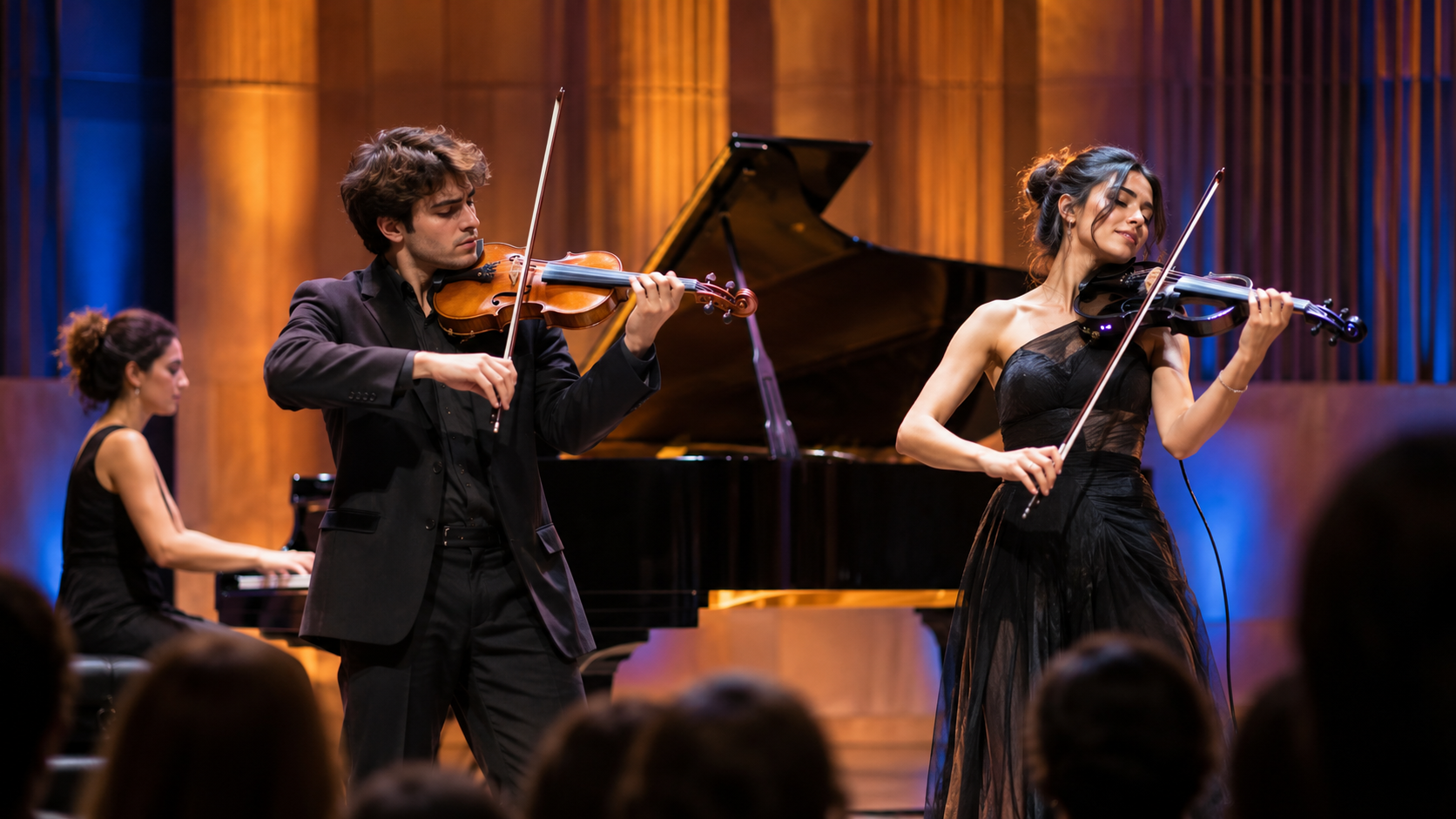
The Violin Channel reported that the violin duo Hina & Fiona performed at London’s Wigmore Hall on 12 November during the Pentatone 25th Anniversary Festival. With pianist Maximilian Maisky, they gave the official world premiere of Madeline Barrett’s arrangement of Schubert’s Fantasie in F minor, D. 940, for two violins and piano. The programme also included arrangements connected to Sarasate, Wagner, Wilhelmj and Zarzycki.
That is more than a clever change of instrumentation. Schubert’s original Fantasie is a long-breathing piano-duet work. Giving its lines to two violinists creates questions of colour, hierarchy and hand-off: who carries the song, who supplies the inner pulse, and when should the two voices sound like a single organism? Those are useful questions well beyond the classical recital room.
- Choose arrangements with a reason, not simply because they add notes.
- Rehearse transitions as carefully as climaxes; the listener notices the hand-over.
- For a duo video or live set, give each player a distinct visual and sonic role.
Tanya’s performer take: an arrangement earns its place when it reveals a new emotional camera angle on music the audience already thinks it knows.
What makes Comesaña’s Vilnius concerto a useful live-music signal?
The Lithuanian National Philharmonic Society schedules Javier Comesaña with the Lithuanian National Symphony Orchestra on 14 November in Vilnius. Conducted by Samuel Lee, the concert places Comesaña in Respighi’s Concerto gregoriano alongside music by Bruch and Mendelssohn. The official listing identifies Comesaña as a prizewinner of the Jascha Heifetz and Joseph Joachim competitions.
For event planners, a programme like this is a model of invitation. A recognised violinist, a named concerto and a varied orchestral frame give an audience several doors into the evening. For performers, Respighi’s concerto is a reminder that projection does not mean permanent volume. The solo line has to stay present through orchestral colour while retaining shape and space.
What can amplified players borrow from concerto thinking?
Build contrast before you need it. In an electric-violin set, decide where the dry sound, a delayed sound, a loop or a wider effect belongs in the story. If every section arrives at maximum width and level, the audience loses its reference point. Dynamic range is stage design for the ear.
Why is Hiu Sing Fan’s new solo video worth a listen?
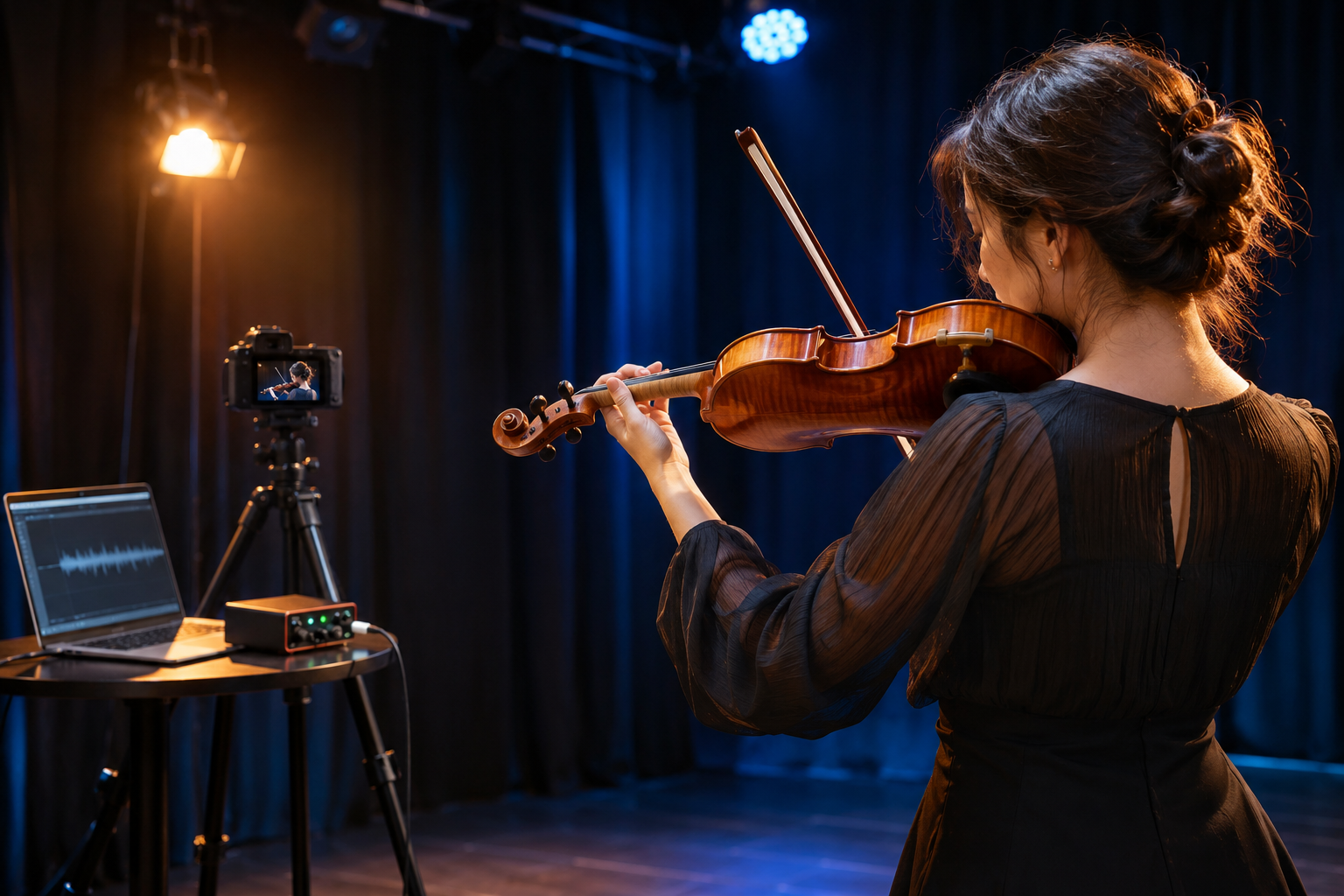
The Violin Channel’s video page added a recording of violinist Hiu Sing Fan playing Nathan Milstein’s Paganiniana on 11 November. The work turns ideas from Paganini’s operatic and violin repertoire into a concentrated solo-violin sequence. Its surface is virtuosic, but a camera makes the musical pacing unusually exposed: there is nowhere to hide a rushed setup, a vague arrival or an unprepared silence.
That is why a polished solo upload is valuable to both music fans and working performers. It gives listeners a direct encounter with detail, while reminding creators that sound, framing and timing belong to the same performance. A phone-screen audience may not name every technique, but it hears confidence in the transitions.
What should performers and listeners take from this week?
Hina & Fiona show how an arrangement can refresh a concert’s identity. Comesaña’s Vilnius appearance shows the power of a well-framed concerto evening. Hiu Sing Fan’s video shows that solo virtuosity can travel through a compact digital format without becoming disposable. Tanya Strings’ practical conclusion is simple: protect the musical core, then make the format intentional. Whether the setting is a recital hall, orchestral stage, festival, private event or short-form video, audiences remember a performer who gives them a clear way into the sound.