Violin News: Demetriades, Radulović and Zhang
This week’s violin news moves between a competition result, a touring chamber ensemble and a virtuoso concerto. Eighteen-year-old Sofia Demetriades has won BBC Young Musician 2026 after playing Tchaikovsky in Bristol. Nemanja Radulović and Double Sens begin a run of US dates with programmes that put Bach, Beethoven, Vivaldi and Rimsky-Korsakov in a compact ensemble setting. In Padua, 2025 Paganini Competition winner Aozhe Zhang takes on Paganini’s Second Concerto. For Tanya Strings, the shared message is practical: a musical identity reaches further when an artist can hold both precision and a clear live point of view.
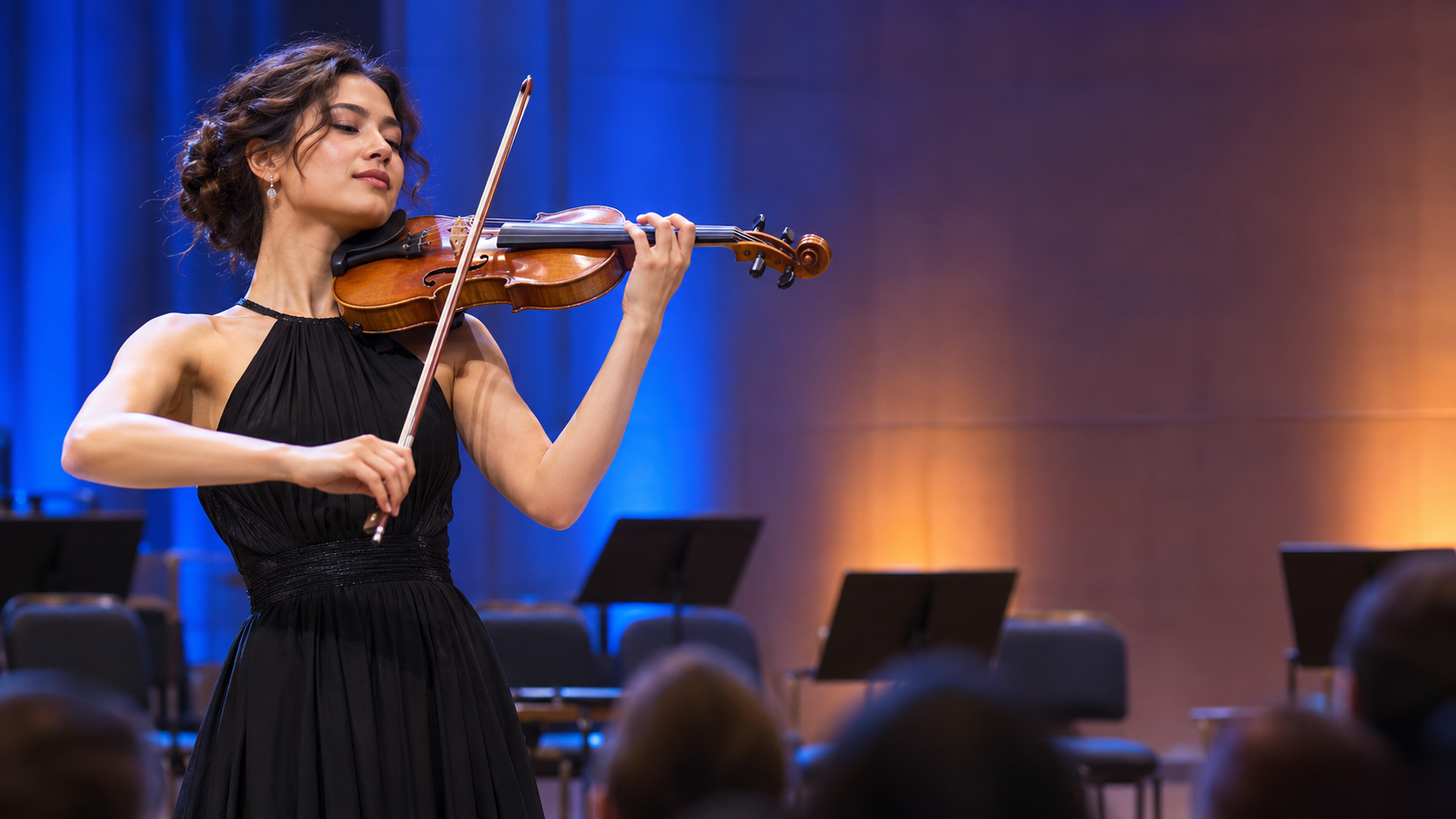
What does Sofia Demetriades’s BBC Young Musician win signal?
BBC Music Magazine reports that Sofia Demetriades, 18, won BBC Young Musician 2026 after performing Tchaikovsky’s Violin Concerto with the BBC National Orchestra of Wales under Alpesh Chauhan at Bristol Beacon. The final also placed recorder player Alma Nunez Debretzeni and saxophonist Kezia Colton beside her, a useful reminder that young-artist platforms ask audiences to listen across instruments, not just compare speed or volume.
A major competition result can open doors, but its real value is the chance to make a first artistic impression at scale. The concerto format is unforgiving in a productive way: intonation must remain secure, the phrase needs direction through long spans, and the soloist has to communicate with an orchestra rather than simply play in front of it.
- Build a competition or audition video around a complete musical idea.
- Let the loudest passage serve the arc instead of becoming the whole message.
- Prepare a concise introduction that tells presenters what makes your programme yours.
Tanya’s performer take: recognition matters most when it turns into an invitation for listeners to follow the artist’s next chapter, not a label they must defend.
Why is Radulović’s Double Sens route worth watching?
Nemanja Radulović’s official tour calendar lists Double Sens in Princeton on 12 November, Boston on 13 November and New Canaan on 15 November, before further US stops. The listed repertoire changes by date, pairing his violin with the group’s chamber scale and drawing from Bach, Beethoven, Vivaldi and Rimsky-Korsakov.
For a touring performer, that format has a strong production lesson. A smaller unit can make classical repertoire feel physically close without shrinking the ambition of the playing. It also makes responsibility audible: every player must project rhythm, intonation, cueing and energy with no large orchestral texture to conceal an uncertain transition.
What can electric violin performers borrow from chamber touring?
Think of a backing track, loop or click as a fellow musician, not a safety net. Know where the phrase breathes, where a cue may change, and how to finish a section cleanly if the room or rig behaves differently from rehearsal. The best hybrid sets retain the alertness of chamber music.
Why does Aozhe Zhang’s Paganini date still feel current?
The Padua event listing places Aozhe Zhang, identified there as the 2025 Paganini Prize winner, with the Orchestra of Padua and Veneto on 12 November at Auditorium Pollini. Under conductor Jonathan Berman, Zhang is scheduled to play Paganini’s Second Violin Concerto, including its famous “La campanella” finale.
Paganini is often filed under spectacle, but a public performance only works when its detail stays legible: left-hand clarity, bow articulation and a sense of play in the timing. For event planners, a named concerto is a useful anchor. It tells newcomers they are coming to a focused live occasion, while giving experienced listeners plenty to listen for.
What should performers and listeners carry from this week?
Demetriades shows the force of a first big platform. Radulović’s route shows how a recognisable artist can keep repertoire mobile and personal across venues. Zhang’s Padua date shows that virtuosity still earns attention when it is shaped as communication. Tanya Strings sees one thread through all three: world-class playing has to travel beyond technique. Whether the audience is a jury, a chamber hall, a festival crowd or a phone screen, make the sound intentional, the programme memorable and the human connection immediate.