Violin News: Looping, Toronto and Wieniawski
Today’s violin news lands in three very different rooms, but each makes the instrument’s live identity clearer. In Sedona, Tyler Carson is presenting a one-person, loop-pedal-led violin show built around a rare horn violin. In Toronto, Irmina Trynkos joins Sinfonia Toronto for a programme that gives Canadian premieres as much weight as familiar repertoire. In New York, the 2026 Kosciuszko Foundation Wieniawski Violin Competition heads toward its public final on November 8. Tanya’s performer take: the strongest violin projects make one idea easy to see and hear, whether that is a self-contained stage world, a deliberately shaped programme or a focused competitive moment.
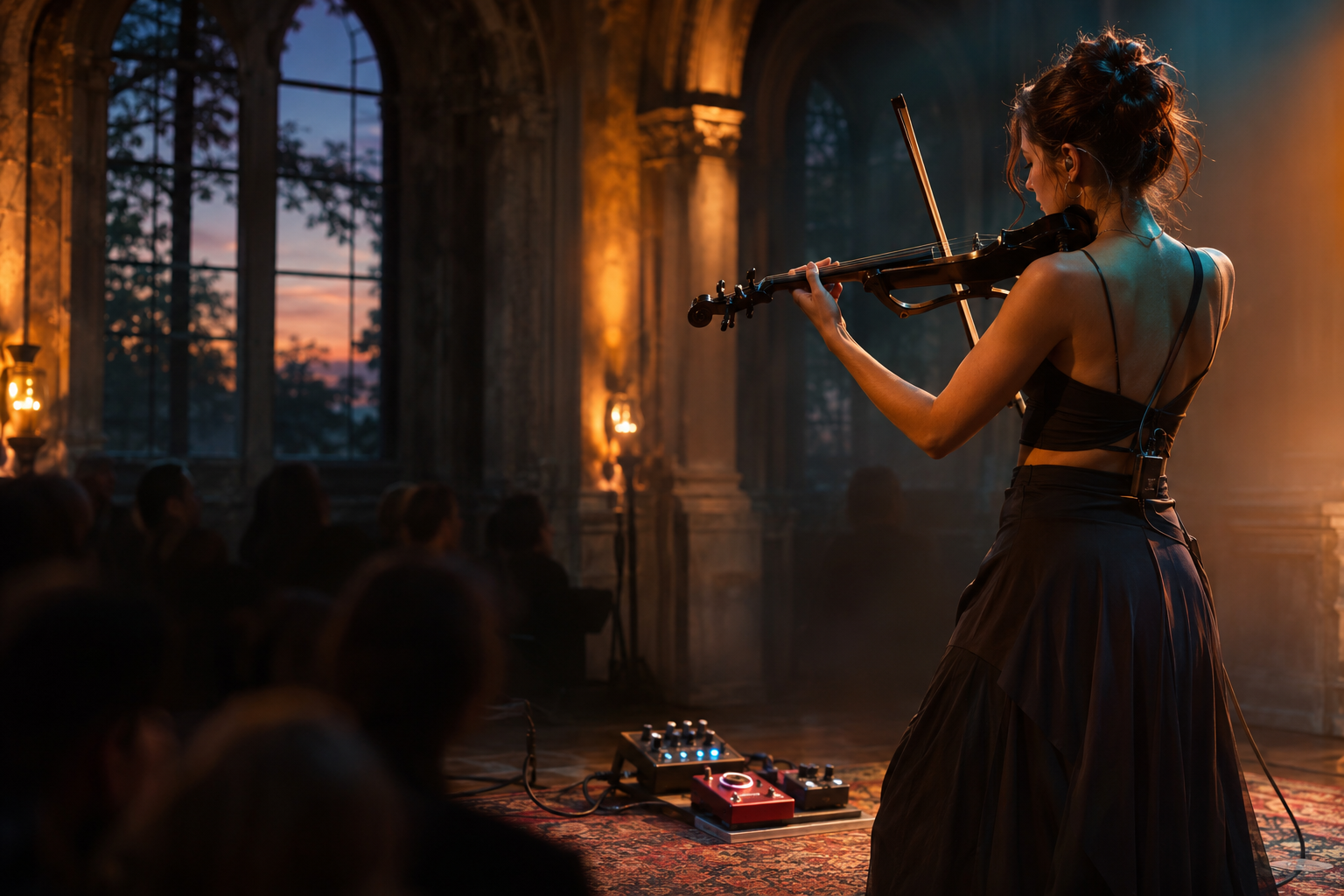
What does Sedona’s looping violin show reveal about a solo set?
The Sedona Chamber’s listing for Fiddler on the Rock places violinist Tyler Carson at the Historic Apple Barn on November 5. The event describes a “One Man Symphony” assembled with live loop pedals and a horn violin, moving from Led Zeppelin to Taylor Swift alongside original material. It is a useful example of a solo performer designing the whole musical frame rather than simply filling time between pieces.
Looping works best when its role is obvious. A first phrase establishes the musical character; a second layer earns the wider sound; a later change resets the audience’s ear. That is a much more compelling arc than adding layers because the technology is available. The horn violin is also a reminder that visual identity can support a set, provided the sound and storytelling remain the centre.
- For electric violinists: rehearse the first 20 seconds of every loop scene until the entry is calm and repeatable.
- For event planners: show the audience a short performance clip that explains the format before tickets go on sale.
- For creators: capture one complete build, including the silence before the first loop, not only the finished wall of sound.
Tanya’s take: a pedalboard should make a musical sentence clearer. For a world-class electric violin show, the audience should feel the build before they need to understand the routing.
Why is Sinfonia Toronto’s programme more than a standard concerto night?
Sinfonia Toronto’s season page lists Irmina Trynkos for November 5 at Trinity-St. Paul’s Centre, conducted by Nurhan Arman. The programme pairs Mieczysław Weinberg’s Concertino for Violin, marked as a Canadian premiere, with Claudia Montero’s Latin Grammy-winning Violin Concerto, also listed as a Canadian premiere. Mozart, Levon Sharafyan and Peter Warlock complete the string-orchestra evening.
Its value is in the contrast. A concise concert can carry unfamiliar pieces when the listener is given different routes in: a twentieth-century concertino, a contemporary concerto with a clear credential, then repertoire whose style changes the temperature of the room. For artists building festival or corporate sets, this is the programming lesson: variety does not mean a random sequence. It means purposeful changes in pulse, colour and scale.
What should a presenter communicate before the first note?
Name the soloist, state what is rare about the programme and make the emotional proposition readable. That can be a sentence in a listing, a short stage introduction or a vertical video. The goal is an invitation, not a lecture.
Why watch the Wieniawski final in New York?
The Kosciuszko Foundation’s official final-round announcement schedules three finalists for November 8 at its New York headquarters. Each will perform a Wieniawski violin concerto, with more than $20,000 in cash prizes and special awards attached to the 2026 competition. The public-final format gives listeners a direct way to compare how distinct artists shape the same composer under the same conditions.
For emerging performers, competitions can be useful beyond the result: they expose how repertoire choice, stage preparation and communication carry pressure. For fans, the useful listening question is simple: which player makes the concerto’s larger line audible while keeping the bravura alive? For bookers, such finals are a reminder that a clear format creates attention. A shared repertoire anchor makes a new name easier for an audience to remember.
What should violin audiences carry into the weekend?
These stories point in one direction: define the experience. Carson uses loops and an unusual instrument to create a self-contained show; Trynkos appears in a programme whose premieres have a reason to be there; the Wieniawski finalists meet through a shared concerto tradition. Tanya Strings brings that same focus to electric violin performance and content: a recognisable sound, production that serves the music and a live moment worth filming because it is already worth hearing.