Violin News: Sibelius in London, Sydney Competition and New Strings in New York
Today’s violin news connects three useful views of a performing life: the soloist in a major concert hall, the young player stepping into a live competition, and an ensemble giving new music its first public hearing. In London, Liya Petrova joins the Royal Philharmonic Orchestra for Sibelius. In Sydney, the Singapore International Music Competition’s Australia live round moves to violin on October 9. In New York, Momenta Festival ends with a new string-quartet premiere. Tanya’s performer take: the repertoire changes, but each occasion depends on presence, preparation and a clear invitation to listen.

Why is Liya Petrova’s Sibelius date a strong concert-story example?
The Royal Philharmonic Orchestra’s official listing places Liya Petrova, its 2026–27 Artist-in-Residence, at Cadogan Hall on October 8 with conductor Adam Hickox. Petrova plays Sibelius’s Violin Concerto; the programme opens with Grażyna Bacewicz’s Overture and closes with Vaughan Williams’s Fifth Symphony. It is a compact piece of concert programming with a real emotional trajectory: bite and brightness, a vast solo landscape, then a reflective orchestral finish.
Sibelius is often presented as a technical summit. Yet a memorable performance also relies on the architecture around it: the listener needs a reason to enter the room, a sense of what they will encounter, and an ending that lets the evening breathe. The RPO names the players, repertoire, time and venue without fuss. That clarity is a practical model for any artist announcing a recital, crossover set or festival slot.
What can an electric-violin performer borrow from that approach?
- Give the set a shape: an immediate opener, a centrepiece with room to develop, and a final number that resolves the energy.
- Share the essentials in one post: date, venue, collaborators, ticket link and one sentence about the musical journey.
- At soundcheck, make the lead tone serve the room rather than compete with the rest of the arrangement.
Tanya’s performer take: virtuosity reaches further when the audience knows where the music is taking them. A stage plot and a social caption can both protect that story.
What is happening for young violinists in Sydney?
The Singapore International Music Competition’s rules page confirms that its Australia live round takes place in Sydney on October 8–9, with the violin category scheduled for October 9 at Willoughby and Northbridge Uniting Church. The competition is open to players aged 30 and under, and organisers say selected top performers can be invited to the winners’ gala concert at Singapore’s Esplanade in December.
That detail matters beyond the result list. A regional live round makes an international platform tangible: musicians play in a room, receive a moment of concentrated attention and can connect an individual appearance to a larger network. For fans and local bookers, it is also a chance to hear emerging artists before the biographies are already written.
Competitions are not the only measure of a career, and they do not need to be. But a well-prepared appearance develops habits that travel: checking the venue route, understanding the piano or PA setup, arriving with clean parts, and leaving with one thoughtful image or clip that accurately represents the sound.
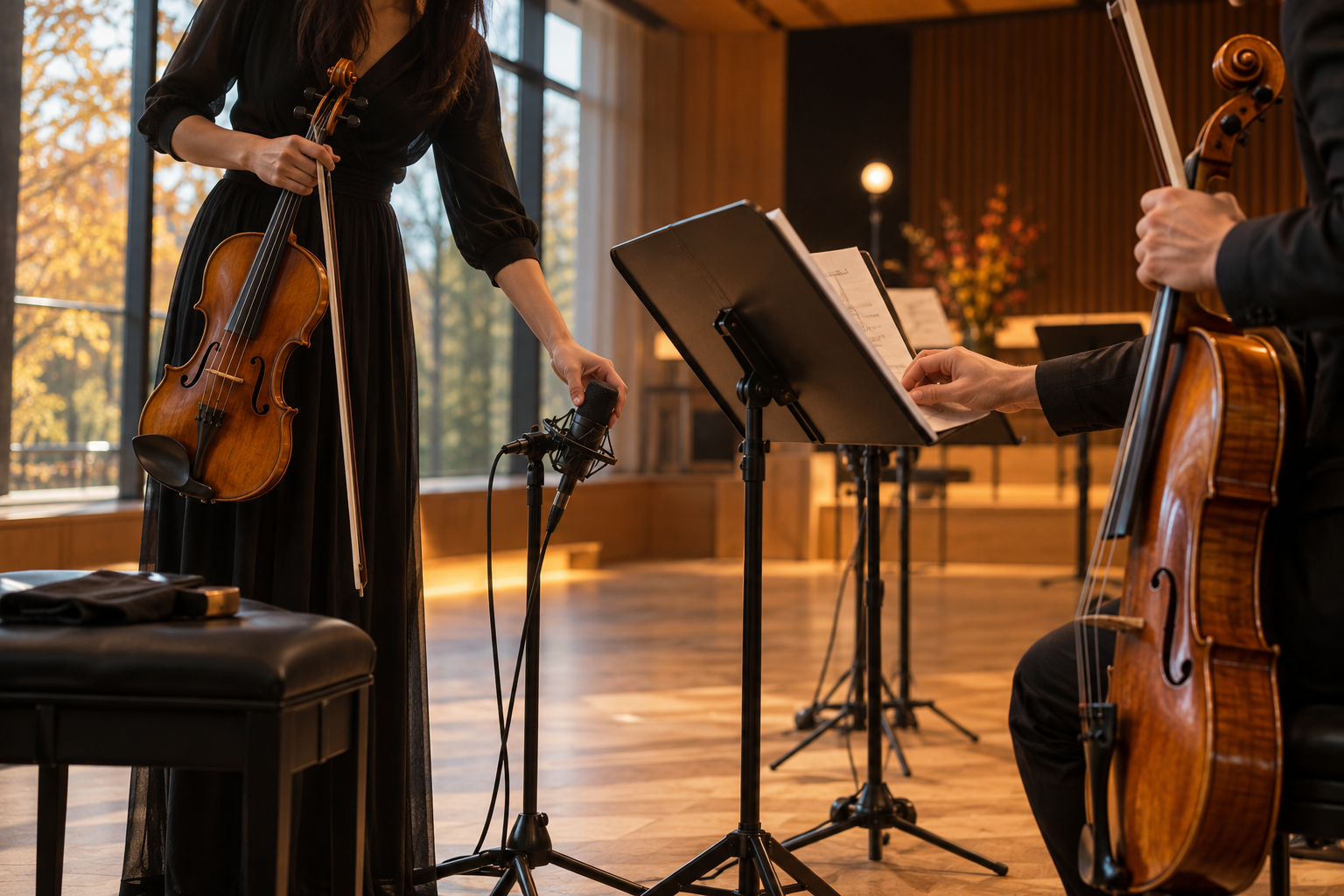
Why does Momenta Festival’s closing programme matter?
The Momenta Quartet’s festival announcement lists October 8 as the finale at Americas Society in Manhattan. The programme includes the world premiere of Gordon Beeferman’s String Quartet No. 2, Aruán Ortiz’s Three short stories about the Big Bang Enigma, and improvisations by Beeferman, Ortiz and violist Stephanie Griffin. The festival has offered free admission throughout its October 2–8 run, with reservations required for the Americas Society dates.
New work needs a human frame, not an apology. Here, the programme does not isolate a premiere as an intimidating duty; it puts composition, improvisation and performer collaboration in the same evening. That is useful thinking for classical-crossover artists too. An original track can sit beside an arrangement or a familiar theme when the transitions make the listener curious rather than defensive.
What should listeners and bookers watch next?
London listeners can follow Petrova and the RPO tonight; Sydney audiences can look toward the violin live round on October 9; and New York listeners can catch Momenta’s final programme. Tanya Strings approaches world-class electric-violin performance and creator work from the same place: strong musical identity, dependable production and a generous way of bringing the audience into the live moment.