Violin News: HIMARI’s Debut, Yu-Peng Chen’s New World and the Chamber Stage
This week’s most useful violin news is about translation: turning a major live appearance into a lasting recording, bringing a game-music audience into the concert hall, and giving chamber musicians a continuing home rather than a one-off date. HIMARI’s first Decca album arrives with a Berlin Philharmonic document; Yu-Peng Chen releases a symphonic project featuring Daniel Hope; David Finckel and Wu Han share Beethoven with six violinists; and the Paddington Trio gains an Associate Artist role at Lichfield Festival. For performers, presenters and fans, the common thread is clear: the strongest projects make an artistic identity easy to hear, see and follow.
Why does HIMARI’s debut matter beyond a headline?
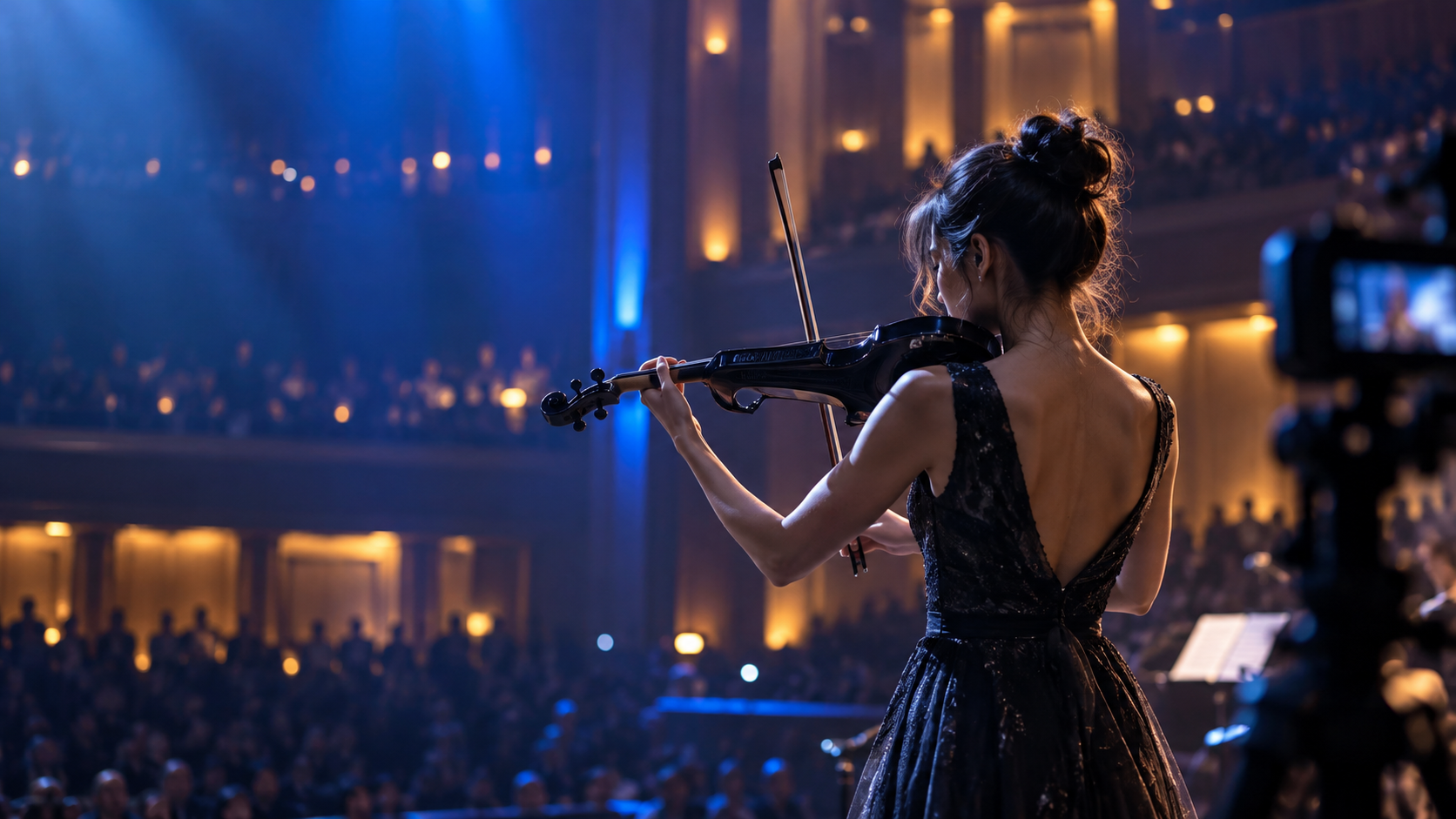
HIMARI’s new Decca Classics album, released September 25, puts Wieniawski’s First Violin Concerto at its centre. It preserves her 2025 Berlin Philharmonic debut with Sebastian Weigle, then pairs it with shorter works alongside pianist Chelsea Wang. The concerto establishes scale, while the smaller pieces give the listener close-up access to colour, articulation and musical personality.
The release also carries a practical message for artists and content creators. A high-profile performance is valuable, but a career story becomes easier to follow when the repertoire, collaborators and visual language point in the same direction. The label’s album page confirms the September 25 date and repertoire line-up, including Chopin, Godowsky and Sibelius.
Tanya’s performer take: do not treat your best live footage as an isolated trophy. Give it a sequel: an intimate arrangement, a rehearsal insight or one concise video that lets viewers meet the musical idea behind the big moment. That is how a concert clip becomes a relationship with an audience.
- Plan one long-form performance asset and two smaller companion pieces.
- Tell audiences what makes a debut programme personal, not merely difficult.
- Listen for the contrast between concerto projection and close-miked recital pieces.
How can a game-music audience meet a symphonic release?
Composer, pianist and producer Yu-Peng Chen released The Poem of Life on Deutsche Grammophon on September 25. The twelve-movement orchestral work comes from a musician known to millions for game scores, and features the Shanghai Philharmonic under Zhang Liang with violinist Daniel Hope, mandolinist Avi Avital and cellist Philipp Schupelius. DG describes the project as a meeting of Western orchestral tradition, Chinese musical heritage and a personal concert-focused language.
Chen has built an audience through narrative music, where atmosphere and emotional pacing are central. A symphonic release can preserve that directness if the listener receives a clear invitation: a track to begin with, a visual world, and a reason to spend twenty minutes rather than twenty seconds. For electric violinists, this is familiar territory. A loop, cinematic patch or crossover arrangement works best when it carries a melody that a new listener can follow immediately.
What does Beethoven with six violinists reveal about recording choices?
Cellist David Finckel and pianist Wu Han’s new Beethoven: The Six Piano Trios assigns each trio to a different violinist: Chad Hoopes, Kristin Lee, Arnaud Sussmann, Danbi Um, Benjamin Beilman and Paul Huang. The reported recording approach placed each player in residence at the duo’s home studio for an individual work. A complete cycle need not flatten its personality. A consistent core can make room for changing voices.
That idea travels well to stage programming. If a performer is building a 45-minute electric violin set, one tonal character can unite it, while different guest musicians, song choices or visual chapters keep the show alive. Consistency is not repetition; it is a promise that the audience learns to recognize.
Why is the Paddington Trio’s festival role worth watching?
On September 25, Lichfield Festival named the Paddington Trio an Associate Artist. Violinist Tuulia Hero, cellist Patrick Moriarty and pianist Stephanie Tang will begin the role with an October concert. This kind of partnership gives chamber music something unusually valuable: recurring context. Instead of asking every concert to introduce the artists from zero, a festival can let audiences recognize a group’s sound across seasons.
Tanya’s performer take: the most durable visibility is built through return dates and a recognisable live world. Whether you play acoustic chamber music or electric violin for festivals and events, make the next appearance feel connected to the last one while still offering a fresh reason to come back.