News · 2026-08-22
Violin News Roundup: Joshua Bell's Paganini Drop, Esther Abrami's Creator-to-Label Leap, Grafenegg's Rescue Recital, and Montreux's Festival-Tech Scale
As of Saturday, August 22, 2026, the violin story worth watching is not only about who played best last night. It is about how the instrument is being packaged across elite recording, creator-led audience growth, premium festival rescue work, and live-production scale. Joshua Bell's new PAGANINI landed on August 21 with the Academy of St Martin in the Fields. Esther Abrami's new Amour single arrived the same day with a sharper creator-to-label narrative. Today's Grafenegg recital keeps a violin program alive after a late pianist change. And Shure's Montreux recap shows what world-class event infrastructure now looks like.
Follow Tanya Strings on Google
Add the site as a preferred source to see more new violin posts from Tanya Strings in Google.

Why does Joshua Bell's new PAGANINI release matter right now?
Because it treats canonical virtuosity as a current leadership statement rather than as museum repertoire. Jensen Artists' August 21 release note says the digital-only album pairs Bell with the Academy of St Martin in the Fields in Paganini's First Concerto, adds Bell's own new cadenza, includes Cantabile in a James Stephenson arrangement, and even brings in a bonus-track Carnival of Venice. Bell is heading into his fifteenth season as ASMF's Music Director, so this is not only a star soloist taking another virtuoso lap. It is a leader-soloist relationship being repackaged for streaming-era listeners in a way that feels immediate, legible, and easy to market.
Tanya's performer take: violinists should notice how clearly the offer is framed. Technical difficulty alone does not create momentum anymore. The audience has to understand why this artist, this orchestra, and this piece belong together now, not just historically.
What does Esther Abrami's Amour rollout say about the creator-era violin career?
It says that audience-building and authorship are finally being allowed to reinforce each other. The August 21 Sony Classical press note distributed by Jensen Artists says Abrami's new single is her violin-and-orchestra take on Bizet's Habanera, while the full album Amour is due on October 9. The more interesting detail is structural: the campaign is centered on Abrami's own nine-part suite, described as the core of the record, alongside reimagined repertoire by Bizet, Poulenc, Gluck, Rota, and others. The same note explicitly positions her as a social media sensation, a visible young violinist in France, and an artist who is now turning reach into a more authored large-scale statement.
Tanya's performer take: world-class performance in 2026 does not require pretending the internet never happened. It requires converting visibility into artistic weight. Abrami's move is interesting because it is not only about content. It is about using audience trust to carry a bigger musical proposition.

Why is Grafenegg's Sergei Dogadin recital more useful than a generic substitute story?
Because it shows how serious presenters protect musical identity under pressure. Grafenegg's official page for Saturday, August 22 confirms that Denis Kozhukhin has stepped in for the injured Daniil Trifonov while the program remains unchanged: Prokofiev's Violin Sonata No. 1 and the Austrian premiere of Shostakovich's 24 Preludes in the violin-and-piano arrangements completed through Dmitri Zyganov and Lera Auerbach. That is a meaningful signal. The festival could have softened the proposition or turned the change into a damage-control event. Instead, it kept a demanding violin program intact and preserved the repertoire story. Audiences forgive late casting changes much more easily when the artistic spine of the evening still feels deliberate.
Tanya's performer take: protect the promise of the set. If a room booked a serious violin experience, keep the artistic line strong even when logistics wobble. That discipline builds trust far faster than overexplaining the problem.
What can violinists and event planners learn from Shure's Montreux recap?
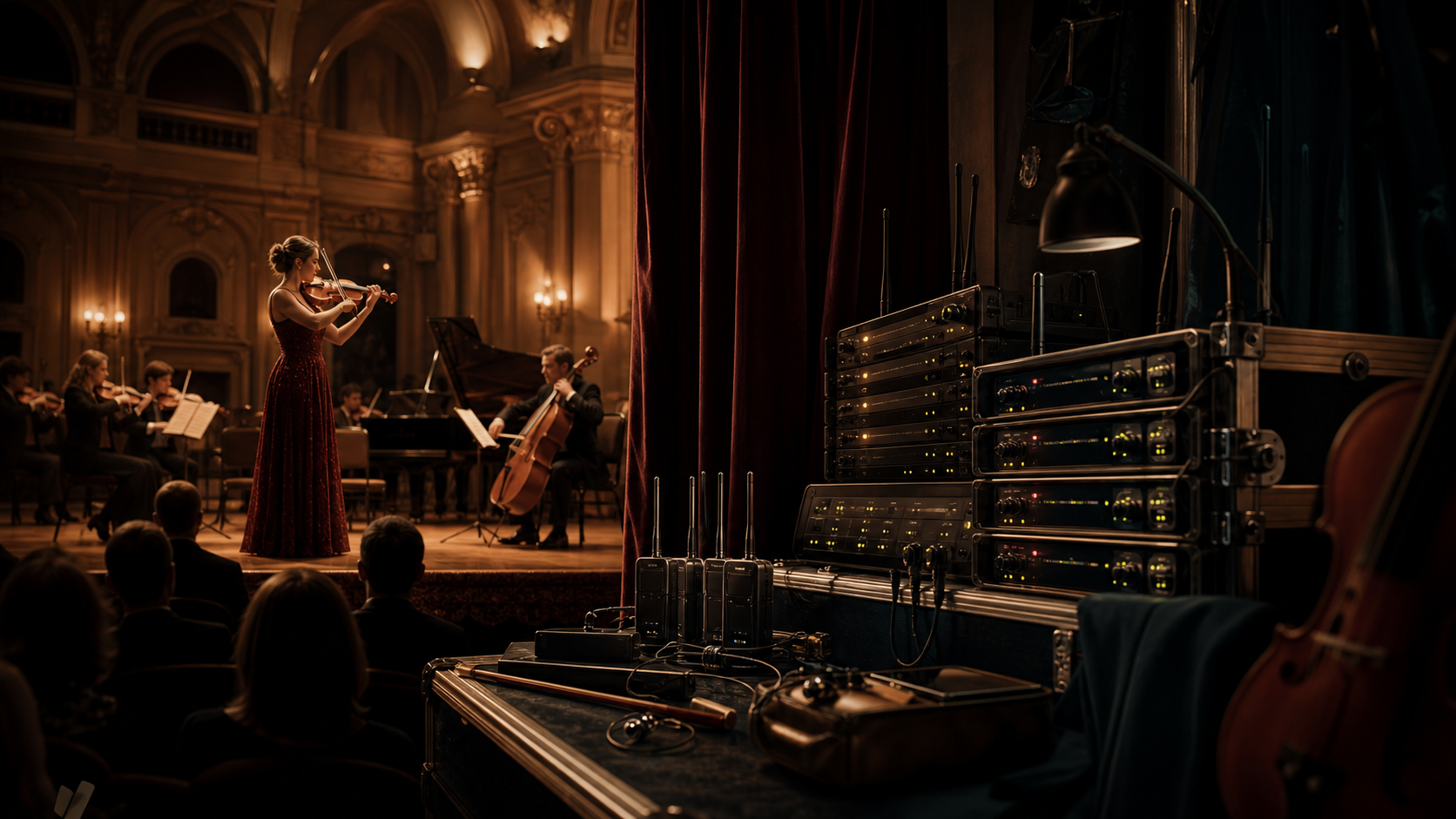
A lot, because this is the infrastructure layer that separates glamorous posters from repeatable live work. In Shure's August 20 press release, the company says it supported the 2026 Montreux Jazz Festival across 10 stages with more than 2,000 audio components, including 156 channels of Axient Digital Wireless, 40 channels of Axient Digital PSM Advanced IEM systems, and 756 wired microphones across more than 300 concerts and activities. For violinists, especially amplified violinists and crossover performers, this is not backstage trivia. It is a reminder that the artist experience, monitor confidence, and room-to-room consistency increasingly depend on wireless management and production teams that can keep complexity invisible to the audience.
Tanya's performer take: if you want a world-class show, stop separating performance from production. A fearless set usually sits on top of boringly reliable wireless, monitoring, and stage communication. That is not anti-art. It is what lets the art land cleanly.
What should performers, planners, and fans watch next?
- Watch which violin releases explain their value in one sentence, because clarity now travels faster than prestige alone.
- Watch creator-led violin artists who turn audience reach into authored projects rather than endless short-form recycling.
- Watch festivals that keep repertoire ambition intact even after last-minute cast changes, because that is a real quality marker.
- Watch the production companies and audio brands behind major festivals, because their workflow increasingly shapes what artists can deliver onstage.