Pedalboards · 2026-07-07
Best Pedalboards for Electric Violinists Who Need Compact Stage Rigs
The best pedalboard for most electric violinists who need a compact stage rig is the Temple Audio Solo 18 because it keeps the footprint small, the cable path tidy, and the board flexible enough for the real pedals Tanya Strings actually uses on gigs. If you want a board that can expand with you, D'Addario XPND 1 is the smarter first buy. Temple Audio Duo 17 is the step-up choice for two-row rigs, D'Addario XPND 2 is the safest growth-minded option, and RockBoard QUAD 4.4 is the pick for bigger hybrid live-and-content setups. Buy for footprint, case workflow, and how fast the rig repeats at soundcheck.
Follow Tanya Strings on Google
Add the site as a preferred source to see more new violin posts from Tanya Strings in Google.
Affiliate disclosure: Some links in this article are affiliate links. I may earn a commission if you make a purchase, at no extra cost to you.

What is the best pedalboard for most electric violinists?
For most working electric violinists, I would start with the Temple Audio Solo series, and the Solo 18 is the size that makes the most sense for a compact live rig. Temple describes its Templeboards as lightweight aluminum pedalboards with built-in cable management, MOD support, and swappable plates, and that matters because electric violin setups rarely benefit from wasted floor space. Tanya Strings needs a board that can move from event stage to content shoot without turning load-in into a cable puzzle. A disciplined one-row board usually wins because it stays visible, reachable, and easier to troubleshoot under pressure.
My performer rule: buy the board for the show you repeat every month, not for the imaginary pedal count you may never actually carry.
Which pedalboards are worth buying right now?
This shortlist stays focused on compact stage logic, clean travel habits, and the kind of electric violin rig that has to work live, on camera, and during quick venue changes.
| Product | Best for | Why Tanya would use it | Watch out for | Links |
|---|---|---|---|---|
| Temple Audio Solo 18 | Most electric violinists who want the safest compact one-row stage board | I like it because the Solo lane stays small, tidy, and realistic for tuner, reverb, wireless, DI, or one multi-effects-heavy violin rig without overbuilding the floor plan. | If your board already needs two rows of pedals or larger switching hardware, do not force a compact frame to do a bigger job. | Official · Amazon |
| D'Addario XPND 1 | Players who want a compact board that can still grow later | I would buy it when I want a small first board that does not punish me for adding one more pedal or changing the rig after a few months of real gigs. | The expandable concept is useful only if you stay disciplined about layout. Expansion is not an excuse to carry clutter. | Official · Amazon |
| Temple Audio Duo 17 | Growing stage rigs that want two rows without jumping straight to a huge board | I would move here when the show needs more switching, a larger wireless path, or cleaner separation between always-on utilities and scene pedals. | Two rows can become visual overkill if your actual violin chain still fits comfortably on one row. | Official · Amazon |
| D'Addario XPND 2 | Electric violinists who know the rig will expand and want a safer long-term board | I would use it when I want the XPND growth logic but already know that one row is too tight for the live and creator system I am actually building. | If the rig is still small, this can be more board than you need and more weight than your venue schedule deserves. | Official · Amazon |
| RockBoard QUAD 4.4 | Bigger hybrid performance and content rigs that still need a flat, organized platform | I would buy it only when the workflow already includes enough pedal-sized hardware that a larger, tougher board starts saving time instead of wasting space. | It is designed for much larger counts, so it makes little sense for a minimalist violin setup. | Official · Amazon |

How much pedalboard space does an electric violin rig really need?
Most electric violinists need less board than guitar marketing makes them think. A serious violin rig can stay compact if the chain is honest: tuner or mute, one tone-shaping tool, one ambience or multi-effects lane, perhaps wireless, and a dependable output path. The board grows when you add backing-track control, heavier scene switching, or content-creator extras that deserve pedal-sized hardware. Tanya Strings is not trying to win a pedal-count contest. I want a rig that sounds consistent, packs quickly, and still leaves room to move on stage.
- Count the real pedals: include wireless receivers, DI-size utilities, and power-routing pieces that live on the board.
- Leave access space: compact is good, but crowded knobs and tangled patch cables slow down soundcheck.
- Think in cases: the carrying solution matters as much as the frame once the calendar fills with gigs.
- Respect the bow hand: if you need to hit a switch mid-set, placement matters more than squeezing in one more effect.
Why is Temple Audio Solo 18 my safest compact pick?
Temple positions the Solo series as compact and minimalist, with one row of pedals and one MOD slot per endcap. That lines up well with how electric violin rigs behave in the real world. I do not need a board that invites endless expansion before the music or the show requires it. I need a board that lets Tanya Strings keep the live chain visible, keep cables controlled, and arrive at a venue with fewer decisions left to make. Solo 18 feels like the right balance between discipline and usability for performers who want their rig to stay small enough to trust.
Who should buy Temple Audio Solo 18 first?
Buy it first if your core rig is already clear and you care more about repeatable stage flow than about future-proofing for an effects collection you may never actually use.
- Pros: compact footprint, clean board logic, built-in cable-management approach, and strong fit for fast live repetition.
- Cons: limited headroom for larger two-row ambitions or pedal counts that are already spilling wider.
See the Temple Audio pedalboard range · Find Temple Audio Solo 18 options on Amazon
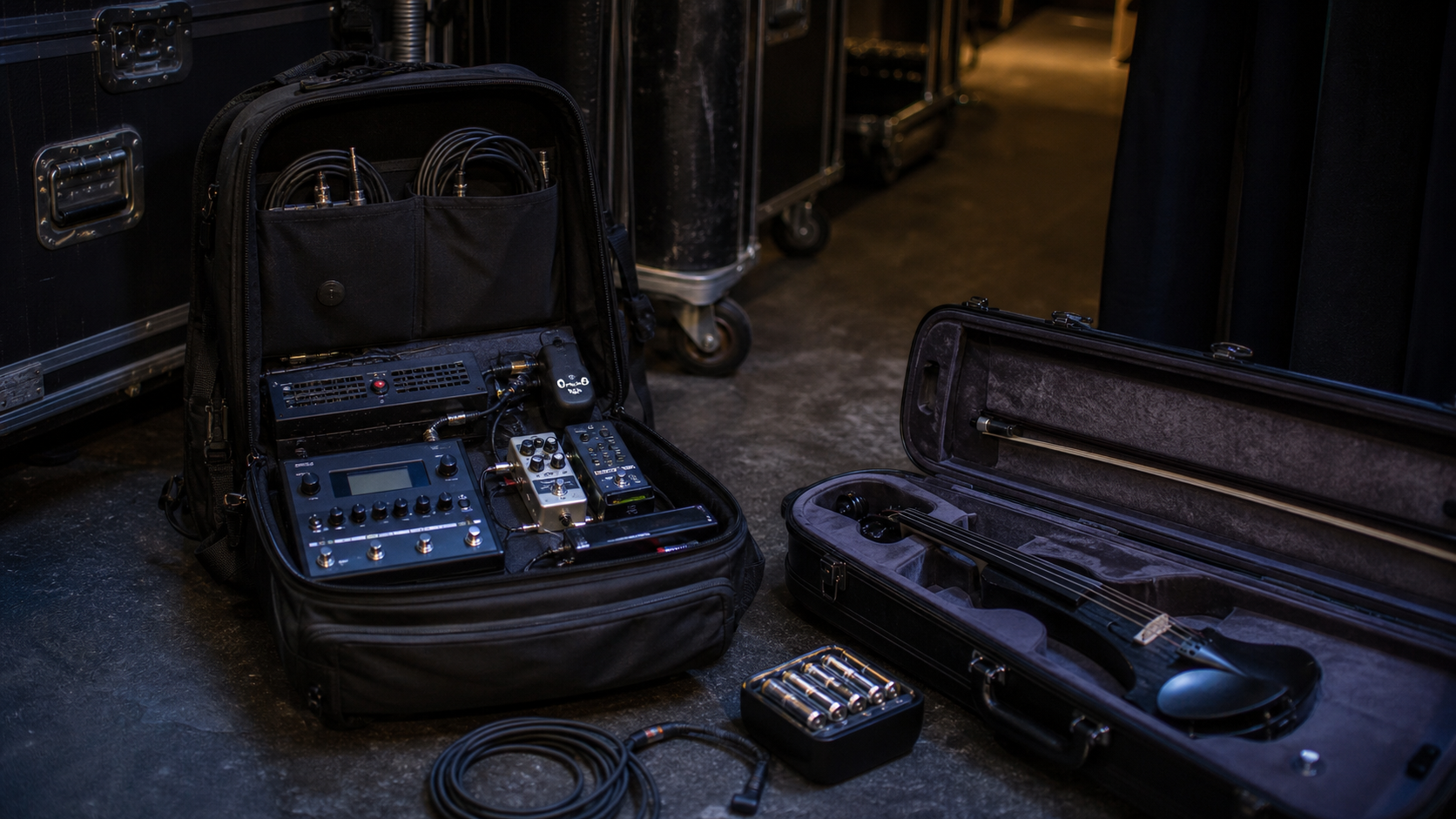
When should you buy D'Addario XPND 1 instead?
D'Addario says XPND pedalboards are made to adapt to you, and the current FAQ is clear about the use case: XPND 1 is ideal when you typically run seven to eight standard pedals and want a compact setup. It also gives you the main XPND advantage, because you can release the latches, slide the board to the desired length, and lock it back in place. That is useful for electric violinists whose rig is still settling. Tanya Strings may add or remove pieces depending on the show, filming setup, or travel day. XPND 1 suits players who want a compact board today without buying a dead-end frame.
What is the real advantage of XPND 1?
The real advantage is not the gimmick of movement. It is the permission to start smaller, then adjust later without rebuilding the whole pedalboard plan from zero.
- Pros: compact starting point, expandable length, clean cable-routing mindset, and strong first-board logic.
- Cons: still a one-row mindset, and the expanding feature loses value if the layout is already messy or oversized.
See the D'Addario XPND pedalboard range · Find D'Addario XPND 1 options on Amazon
Why does Temple Audio Duo 17 make sense for growing stage rigs?
Temple describes the Duo series as room for more and stage ready, with two rows of pedals and more MOD capacity at the endcaps. That is the right moment to step up if your electric violin board has crossed from compact essentials into a more routed performance system. Maybe the show needs dedicated switching, a larger wireless solution, or a board layout that separates utilities from effect scenes. Duo 17 makes sense when the extra row keeps the rig readable rather than bloated. I care about having more space only when it creates calmer footwork and cleaner decisions on stage.
Who actually needs a two-row board?
Two rows make sense when one row is forcing bad spacing, accidental switches, or ugly cable angles, not when you simply want the board to look more serious.
- Pros: more routing room, better separation between functions, and a stage-ready step up from minimalist boards.
- Cons: bigger footprint, more temptation to overfill the board, and less reason to buy it if your rig is still lean.
See the Temple Audio pedalboard range · Find Temple Audio Duo 17 options on Amazon

When does D'Addario XPND 2 become the smarter long-term buy?
D'Addario's current guidance says the main XPND choice is one row or two, and if your needs are bigger or you expect the rig to grow, XPND 2 gives you two rows with significantly more room for expansion. That is a sensible place for electric violinists who already know the setup is headed toward a more layered performance system. I would look here when the board must cover live violin, creator workflow, and enough utility pedals that a minimalist frame is starting to fight back. XPND 2 is less about extravagance and more about giving the rig room to breathe before the show becomes harder to manage.
What are you really buying beyond extra space?
You are buying time. Cleaner cable runs, fewer emergency rearrangements, and less risk that one more needed pedal turns the board into a rushed compromise.
- Pros: two-row growth path, expandable platform logic, stronger future headroom, and solid fit for evolving rigs.
- Cons: more board than many violinists need, and less appealing if the gig calendar still rewards lighter travel above all.
See the D'Addario XPND pedalboard range · Find D'Addario XPND 2 options on Amazon

Who should step up to RockBoard QUAD 4.4?
RockBoard positions QUAD 4.4 for nine to eighteen pedals, and the broader pedalboard series is described as lightweight, torsionally rigid, and built for hard use, with a flat edge-to-edge surface formed from a single sheet of cold-rolled aluminum without welded seams. That is a serious board philosophy, and it belongs only to a certain kind of electric violin setup. Tanya Strings would step up here for a larger hybrid rig where the board is already carrying major switching, utility hardware, and content-oriented extras that have clearly earned the space. If the show is smaller, QUAD 4.4 is unnecessary. If the system is genuinely larger, it starts to look like the calm choice.
When is RockBoard QUAD 4.4 too much board?
It is too much board when your real rig still lives in the compact zone and the bigger frame adds carrying weight and floor sprawl without solving a real show problem.
- Pros: serious size range, flat usable surface, strong large-rig stability, and better sense for advanced hybrid systems.
- Cons: oversized for many violinists, harder to justify for travel-light work, and easier to overfill than a disciplined compact board.
See the RockBoard range · Find RockBoard QUAD 4.4 options on Amazon
What should you check before buying a pedalboard?
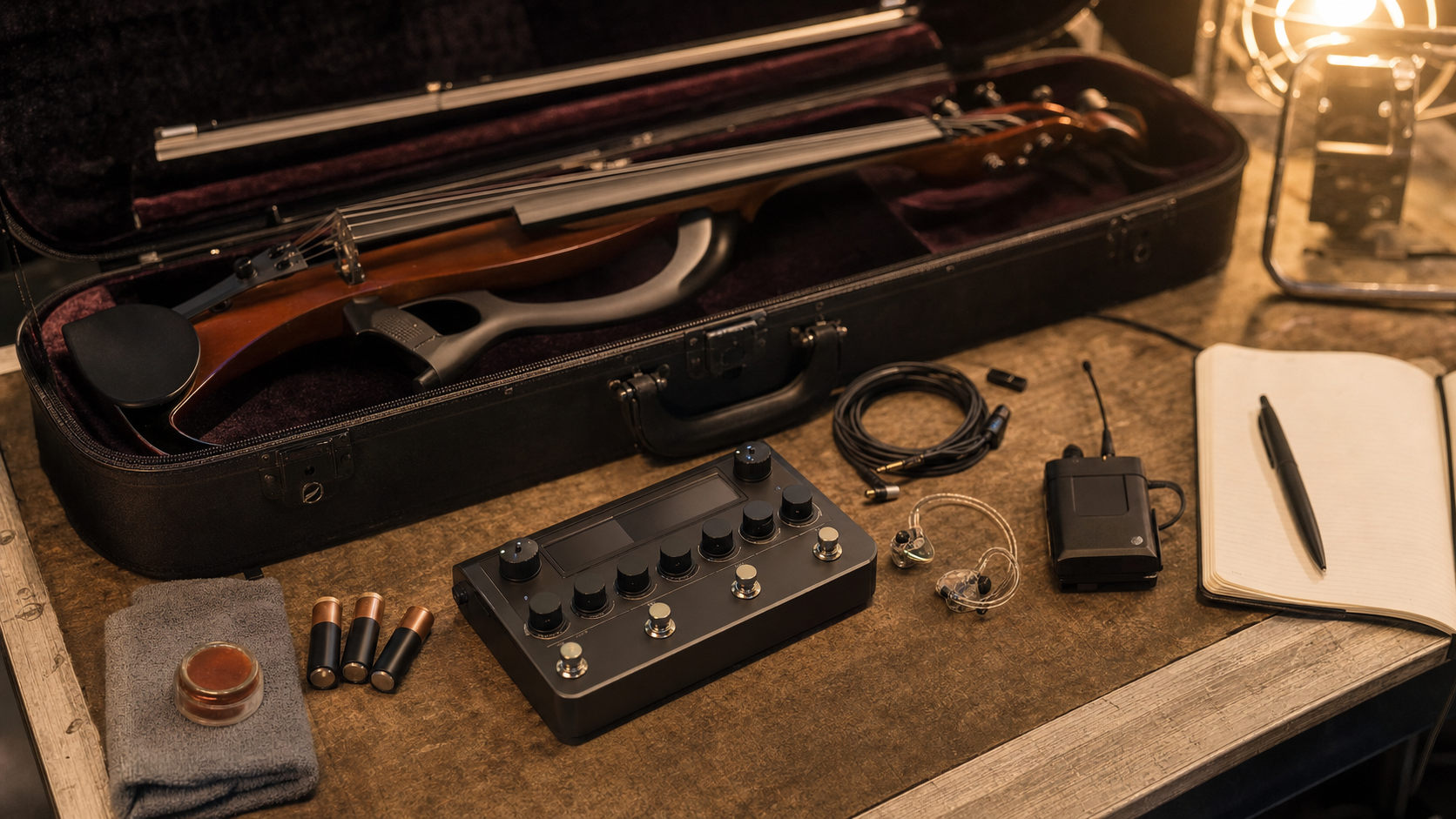
- Measure the real chain: count pedals, wireless hardware, power routing, and the space your foot actually needs between switches.
- Check the case workflow: soft bag, hard case, and load-in speed affect daily use more than marketing copy does.
- Prioritize cable discipline: a neat board is faster to trust when the venue lights are bad and changeover is short.
- Buy for the venue calendar: weddings, clubs, creator shoots, and fly dates often reward compact boards more than giant rigs.
- Leave some growth room: enough to adapt, but not so much that empty space invites bad purchases.
My buying order: if your violin tone path is already stable, the pedalboard should be the thing that makes setup calmer, travel lighter, and the show more repeatable. If it adds chaos, it is the wrong board no matter how impressive it looks online.
FAQ
What is the best pedalboard for most electric violinists?
Temple Audio Solo 18 is the safest overall buy for most players because it stays compact, organized, and realistic for the pedal count that many working electric violin rigs actually need.
How many pedals does an electric violinist usually need?
Many stage rigs can stay in the three-to-six pedal range, especially if one multi-effects unit or one wireless utility replaces a larger collection of single-purpose boxes.
Should I buy a one-row or two-row pedalboard?
Start with one row if your chain is compact and repeatable. Move to two rows when live routing, switching, or creator hardware genuinely needs the space.
Does the case matter as much as the pedalboard?
Yes. A great board still becomes annoying if the carrying setup wastes time, moves badly through venues, or forces you to unplug too much between shows.