Power · 2026-06-26
Best Pedalboard Power Supplies for Electric Violinists on Stage
The best pedalboard power supply for most electric violinists is the Walrus Audio Canvas Power 8 because it gives Tanya Strings enough isolated outputs for a real stage board, two switchable 9V, 12V, or 18V taps for demanding pedals, useful USB-C charging for a phone or tablet, and a slim shape that still fits under travel-friendly boards. If your rig is tiny, buy the Strymon Ojai R30. If you need mixed voltages and straightforward value, MXR Iso-Brick still makes sense. Zuma R300 is the premium expandable move, and Canvas Power 15 is the large-board pick when violin, wireless, and content tools all live together.
Follow Tanya Strings on Google
Add the site as a preferred source to see more new violin posts from Tanya Strings in Google.
Affiliate disclosure: Some links in this article are affiliate links. I may earn a commission if you make a purchase, at no extra cost to you.

What is the best pedalboard power supply for most electric violinists?
For most working boards, I would start with the Walrus Audio Canvas Power 8. Electric violin boards do not need a giant brick just to look serious. They need enough isolated outputs for tuner, wireless receiver, reverb, delay, DI-adjacent utilities, or a compact multi-effects path, while staying slim enough for travel and fast load-in. Walrus says Canvas Power 8 gives eight isolated outputs, two variable 9V, 12V, or 18V outlets, and a USB-C charging output for a phone or tablet. That is a very practical mix for a performer and content creator who wants the board to stay quiet, modern, and bag-friendly.
My performer rule: I would rather own one honest isolated power supply than five clever pedals fed by noisy compromise.
Which pedalboard power supplies are worth buying right now?
This shortlist stays focused on electric violin reality: low noise, enough current for digital pedals, a believable stage footprint, and voltage options that actually help a crossover rig instead of complicating it.
| Product | Best for | Why Tanya would use it | Watch out for | Amazon link |
|---|---|---|---|---|
| Walrus Audio Canvas Power 8 | Most electric violinists who want one modern, stage-ready power supply | I like it because eight isolated outputs, two variable-voltage taps, and USB-C charging cover a serious violin board without making the rig bulky. | It is not a bargain-bin buy, so it makes sense when the board is already real and not hypothetical. | Check on Amazon |
| Strymon Ojai R30 | Slim travel boards that still need higher-voltage flexibility | I would use it when I want a very low-profile board with three 9V high-current outputs and two switchable 9V, 12V, or 18V channels. | Five outputs is enough only if the board is disciplined. | Check on Amazon |
| MXR Iso-Brick | Mixed-voltage pedalboards that need varied output types in one box | I trust it when one board mixes old-school pedals, modern digital units, and occasional higher-voltage needs without much space to spare. | Some outputs are low current, so you have to match each pedal carefully instead of assuming every jack does everything. | Check on Amazon |
| Strymon Zuma R300 | Premium compact boards that need expandable touring logic | I would choose it when I want five high-current isolated outputs, worldwide compatibility, and the option to expand later without rebuilding the board. | It is premium money for a board that still tops out at five onboard outputs before expansion. | Check on Amazon |
| Walrus Audio Canvas Power 15 | Larger electric violin boards with wireless, ambience, utilities, and device charging | I would move here when the board is carrying most of the show and I want 15 isolated outputs plus USB-C charging in one under-board unit. | Buy it for a large board you already use, not because a big number feels reassuring on paper. | Check on Amazon |
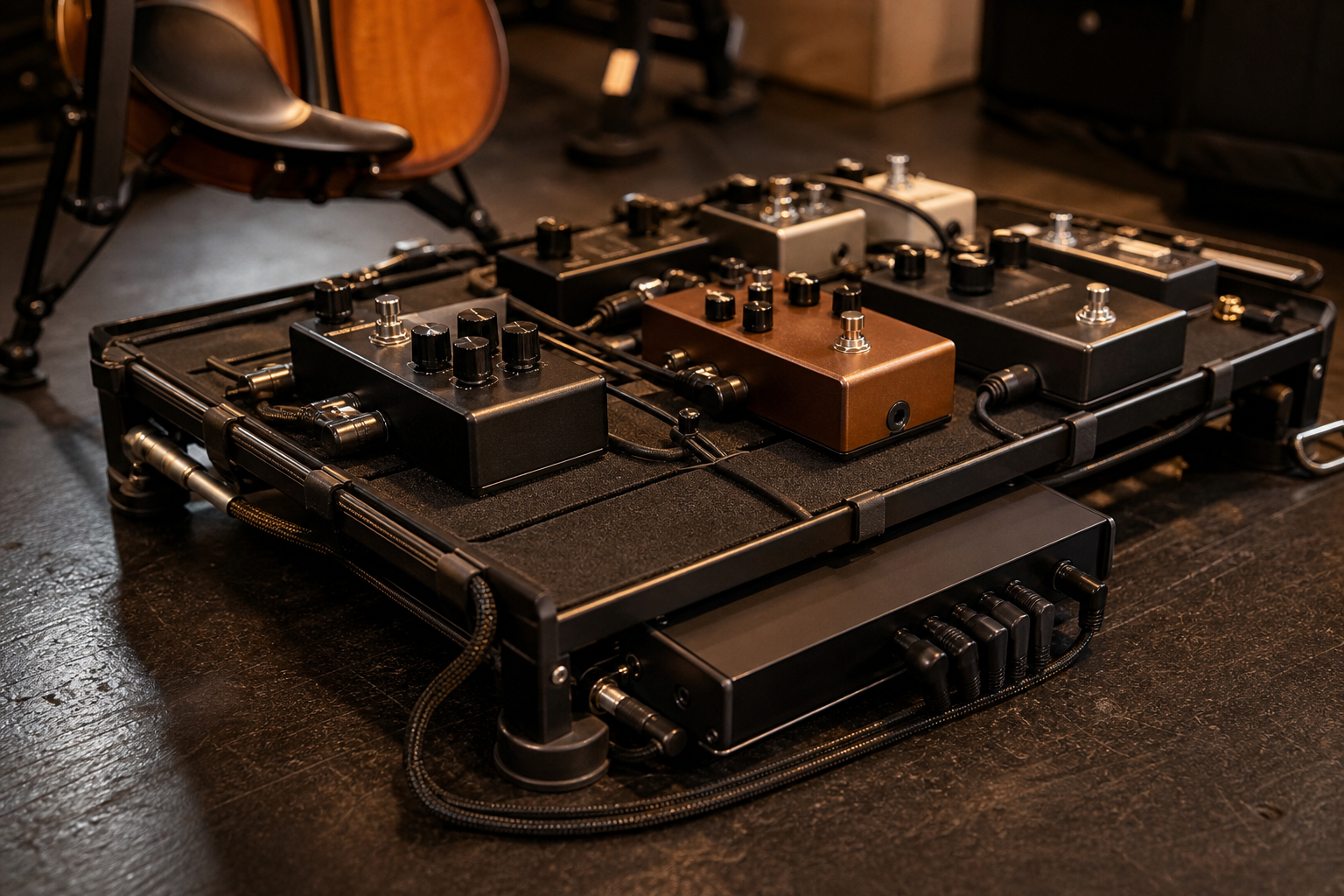
Why is Canvas Power 8 the safest all-around pick?
Canvas Power 8 lands in the middle where many electric violin boards actually live. Walrus says it gives eight isolated outputs, including six 9V 500mA outputs, two variable 9V, 12V, or 18V outputs, and one 5V 1.5A USB-C charging output. It is also only about an inch tall. That combination matters because Tanya Strings may need to power a tuner, wireless unit, delay, reverb, volume pedal companion tools, and still keep a phone or tablet alive for backing tracks, set notes, or content capture. It feels designed for a modern performance day instead of a guitar-only fantasy board.
Who should buy Canvas Power 8 first?
I would buy it first if I want one serious under-board power supply that covers stage work and creator workflow without pushing me into oversized hardware.
- Pros: strong output count, two variable-voltage taps, USB-C charging, slim size, and clear room for a serious violin board.
- Cons: more money than entry-level options and more supply than a very tiny board needs.
See the official Walrus Audio Canvas Power 8 page · Find Canvas Power 8 options on Amazon
When should Tanya Strings choose Ojai R30 for a slim board?
Ojai R30 is the smarter choice when the board is compact and every millimeter matters. Strymon says it gives five isolated outputs: three 9V outputs at 500mA and two selectable 9V, 12V, or 18V outputs, with a low-profile chassis that fits under most boards. That is a strong electric violin story because many performer boards are smaller than guitarist boards. I may only need tuner, wireless, one ambient pedal, and one utility pedal, but I still need enough current and enough voltage choices to keep the rig predictable.
What makes Ojai R30 especially useful for fly dates and minimalist rigs?
Its balance is excellent. It is small enough to travel easily, but it still gives real isolated power and two flexible higher-voltage channels instead of trapping the board in a bare-minimum layout.
- Pros: slim chassis, high-current outputs, two flexible voltage channels, and easy expansion if the rig grows.
- Cons: five outputs disappears quickly if the board adds more than a few pedals and wireless.
See the official Strymon Ojai R30 page · Find Ojai R30 options on Amazon
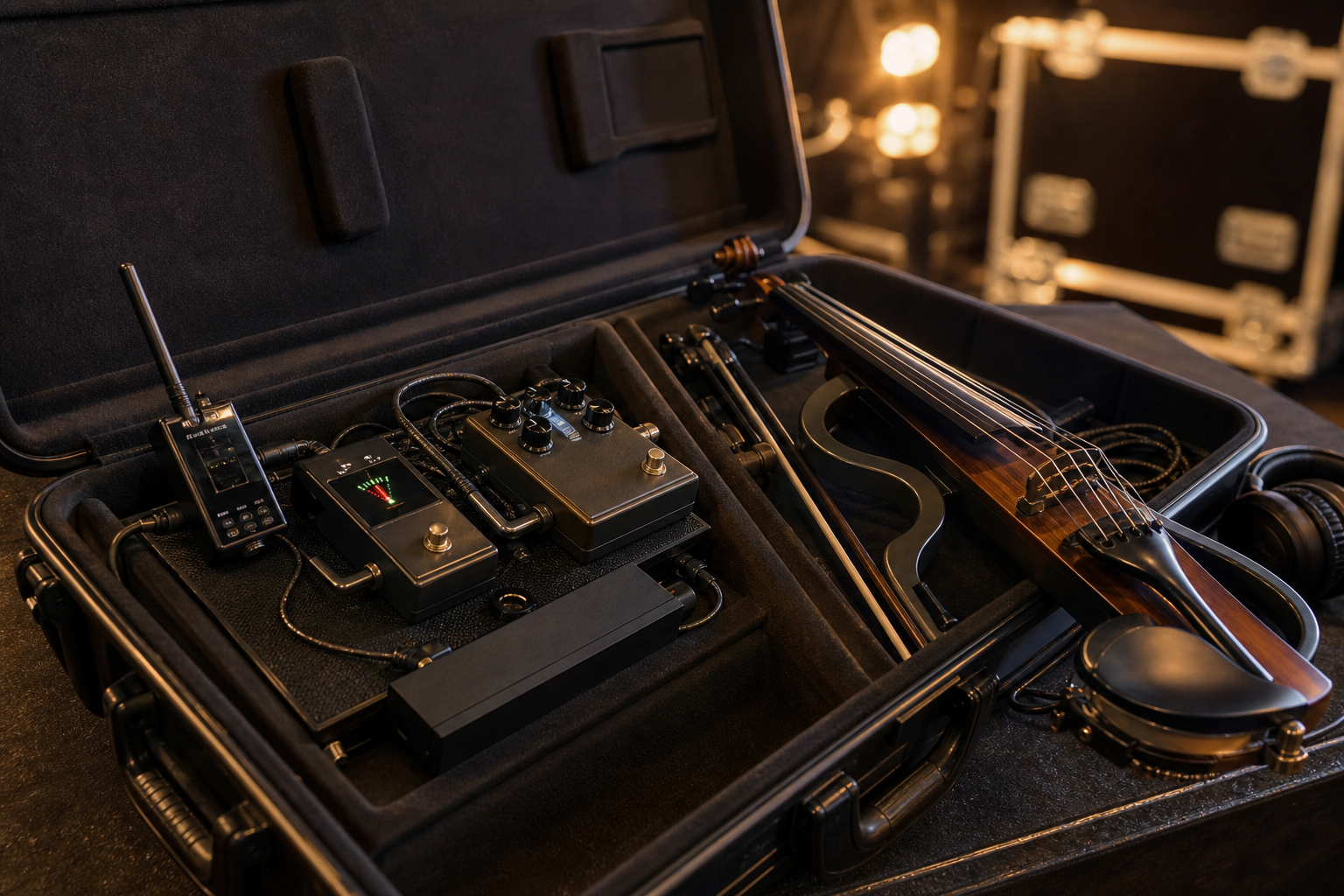
Why would an electric violinist pick the MXR Iso-Brick?
The MXR Iso-Brick is appealing when I want one compact supply that handles a range of output types. MXR says it has ten fully isolated outputs, including 9V, 18V, and two variable 6V to 15V outputs, with specific current allocations across the jacks. That matters for electric violinists because crossover boards can get weird fast. One pedal may want more current, another may want 18V headroom, and an older utility pedal may react better at a lower voltage. Iso-Brick is useful when I want those options in one box and I am willing to map the board carefully.
What is the real tradeoff with Iso-Brick?
The flexibility is real, but the output map is not uniform. I have to know which pedals need 100mA, 300mA, 450mA, or higher-voltage lanes before I call the board finished.
- Pros: ten isolated outputs, mixed current levels, variable-voltage options, and a compact stage footprint.
- Cons: less forgiving than modern all-500mA supplies when the board is packed with hungry digital pedals.
See the official MXR Iso-Brick page · Find Iso-Brick options on Amazon
When does Zuma R300 make more sense than the smaller options?
Zuma R300 makes more sense when I want premium travel logic, very strong current on every main output, and cleaner long-term expandability. Strymon says it gives five fully isolated outputs, four dedicated 9V 500mA outputs, one adjustable 9V, 12V, or 18V output, a 24V thru jack for expansion, and worldwide power compatibility. That fits the player who travels, rents backline, or wants one board that behaves the same whether the gig is local, a fly date, or a filmed set.
Who should pay for the Zuma R300 upgrade?
I would pay for it when the show already depends on a reliable compact board and the next requirement is touring confidence, not just more pedals.
- Pros: premium isolation, worldwide compatibility, strong 500mA outputs, and a clear path to expansion.
- Cons: premium price and only five outputs onboard before you add more hardware.
See the official Strymon Zuma R300 page · Find Zuma R300 options on Amazon
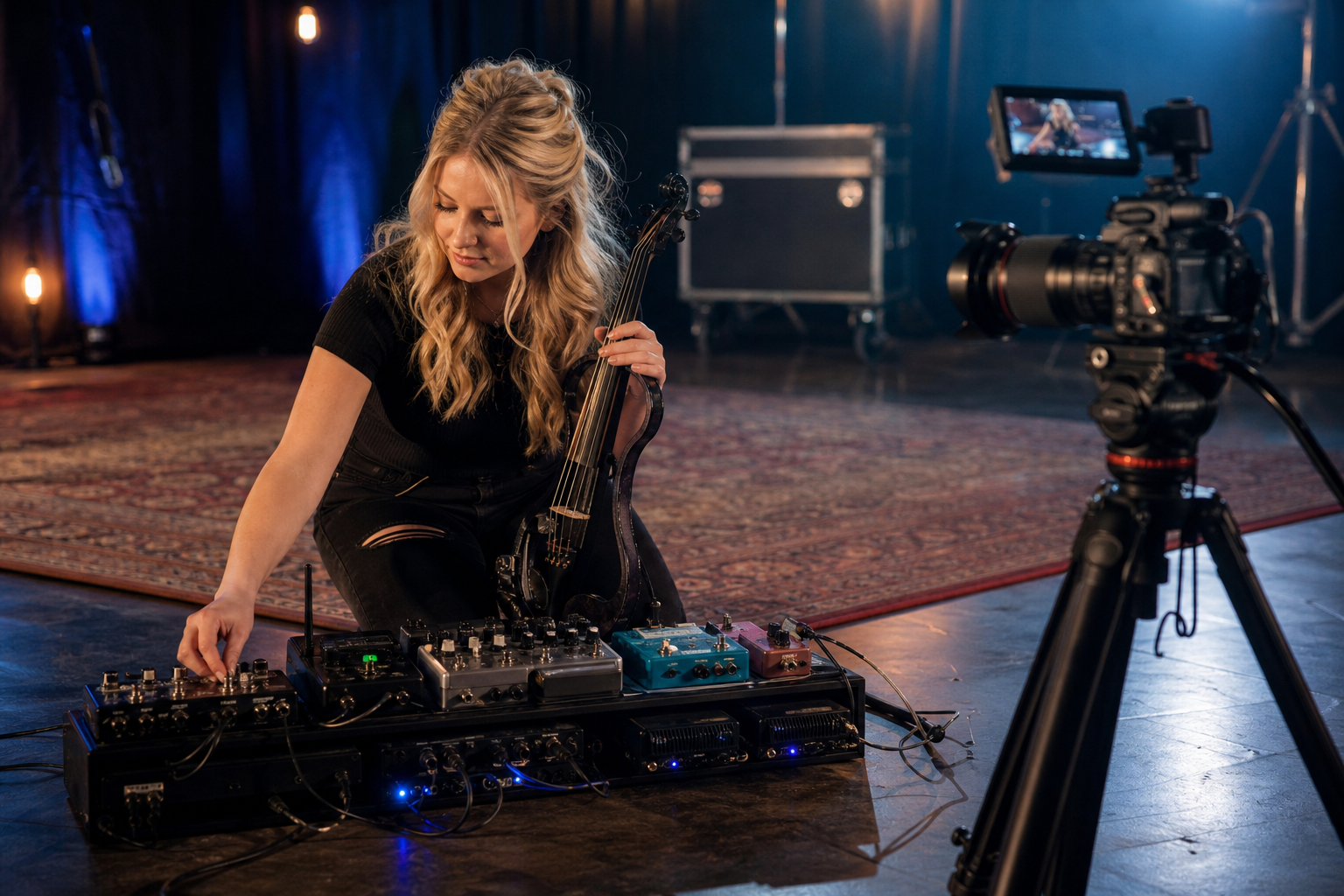
Who should move up to Canvas Power 15?
Canvas Power 15 is for boards that really are the show. Walrus says it offers fifteen isolated outputs, two variable 9V, 12V, or 18V outlets, and USB-C charging in the same slim system approach as the smaller Canvas units. Tanya Strings would move here when the board is carrying wireless, several effects, utility pedals, and device charging for backing tracks or creator workflow. This is not the right buy for a simple violin board. It is the right buy when the board has become a serious live workstation and the goal is one clean under-board solution instead of two half-solutions.
When is the bigger supply actually the cheaper decision?
It becomes cheaper when it replaces add-on expanders, extra wall adapters, and the hours lost to tracing noise or power limits before a set.
- Pros: very high output count, two variable-voltage outputs, USB-C charging, and a strong fit for advanced boards.
- Cons: unnecessary for compact rigs and easy to overbuy if the board is still simple.
See the official Walrus Audio Canvas Power 15 page · Find Canvas Power 15 options on Amazon
What should you buy first if your pedalboard budget is limited?
If money is limited, I would buy in this order:
- Buy the isolated foundation first: one quiet, reliable supply beats adding another effect to a noisy board.
- Buy for the board you already use: if you run a small rig, Ojai R30 or a similarly compact supply is smarter than pretending you need a huge platform.
- Buy the expansion platform later: move to Zuma R300 or Canvas Power 15 only after the workload has become real.
I do not like wasting stage confidence on power drama. The board should help the performance feel settled before the first note.
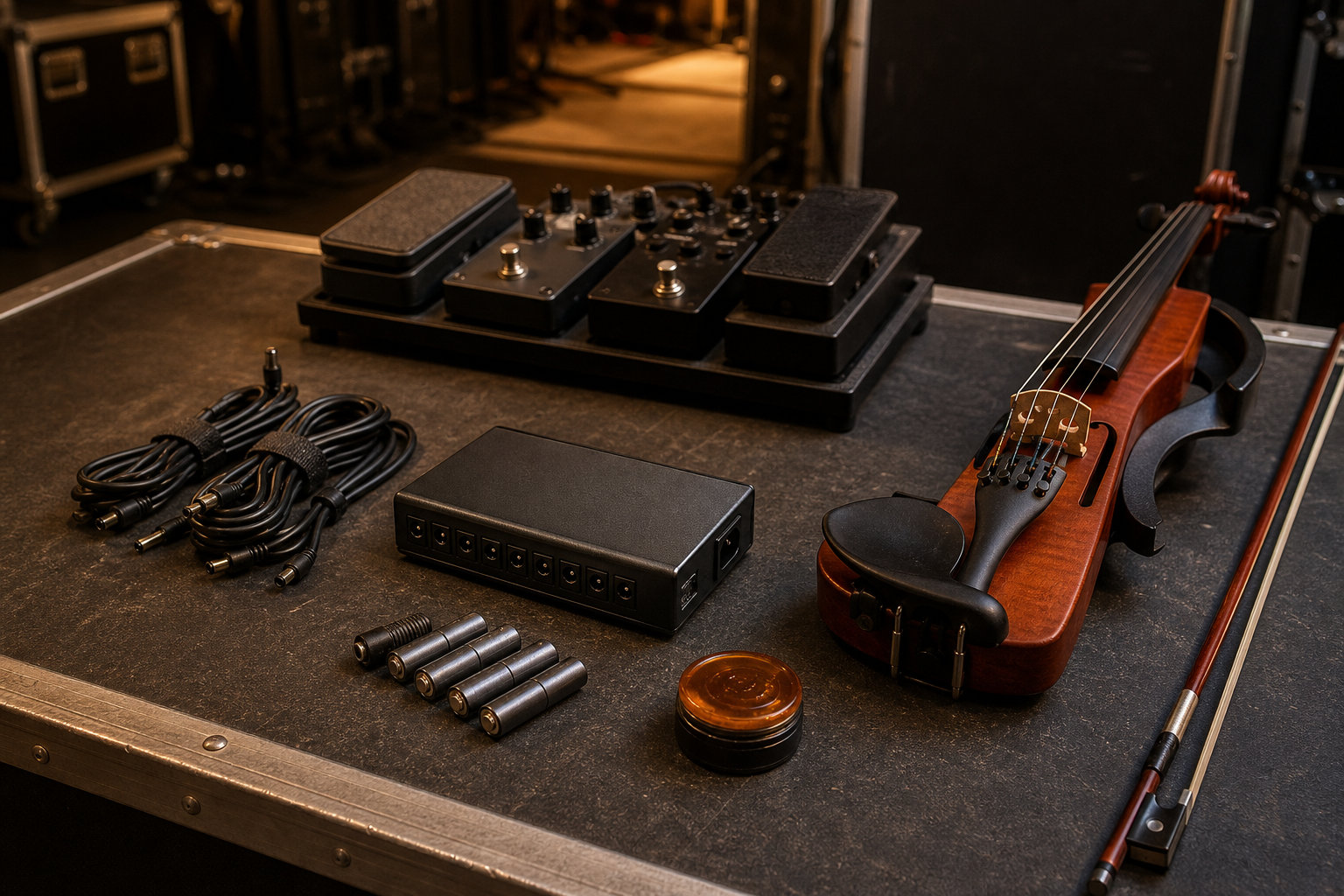
What matters most when choosing a pedalboard power supply for electric violin?
Electric violin exposes weak power faster than many players expect, especially when piezo front ends, wireless, and digital ambience are all living on one board.
- Prioritize isolated outputs: hum and ticking are much harder to forgive than one less effect.
- Check the current honestly: digital reverb, wireless, and utility devices can exceed the comfortable limits of older outputs.
- Respect voltage options: variable 12V or 18V taps help only when the specific pedal is designed for them.
- Keep the physical height realistic: under-board fit matters if the rig has to travel and set up quickly.
- Match the supply to the whole job: if the phone or tablet is part of the show, charging convenience matters too.
How does Tanya Strings keep a pedalboard quiet and show-ready?
I treat pedalboard power like stage preparation, not like an afterthought. For a world-class electric violin performer and content creator, repeatability is part of the art.
- Map every pedal before the gig: I want each current draw and voltage choice decided before soundcheck.
- Keep spare DC leads in the case: one dead cable can look like a dead pedal if the board is rushed.
- Separate signal confidence from gear collecting: I would rather cut one pedal than keep a noisy board alive with excuses.
- Test the board as one show system: violin, wireless, pedals, and playback all have to work together before the venue hears them.
That is how Tanya Strings thinks about power supplies: not as glamorous purchases, but as the part of the rig that lets the performance stay confident, quiet, and ready for both stage and camera.

FAQ
What is the best pedalboard power supply for most electric violinists?
For most players, the Walrus Audio Canvas Power 8 is the safest overall buy because it gives you eight isolated outputs, two variable-voltage taps, USB-C charging, and a slim stage-friendly footprint.
Do I really need isolated outputs for electric violin?
Usually yes. Electric violin rigs expose power noise quickly, especially when wireless receivers, digital pedals, and venue power all meet on the same board.
When is Ojai R30 the smarter buy than a larger supply?
It is smarter when your board is small, your pedal count is disciplined, and you still need real isolated outputs plus a couple of flexible 9V, 12V, or 18V channels.
When should I step up to a big unit like Canvas Power 15?
Step up when the board truly carries a larger live and content workload, not just because a bigger output count feels safer in theory.