News · 2026-06-24
Violin News Roundup: David Garrett's Open-Air Push, Ravinia's Orchestra-Crossover Bet, SHMF's Silent-Film Training, and Santa Barbara's String Pipeline
As of Wednesday, June 24, 2026, the most useful violin news is about how serious presenters are building platforms around strings, not just booking isolated names. David Garrett's live page maps a July and August Millennium Symphony Open Air run built as a crossover show with band and orchestra. Ravinia's July 25 St. Vincent with the Chicago Symphony Orchestra page turns orchestral collaboration into a headline event inside the new Hunter Pavilion. Schleswig-Holstein Music Festival is opening its 2026 Festival Orchestra pipeline, and Music Academy of the West is moving straight from June 24 student recitals to a June 26 String Quartet Showcase.
Follow Tanya Strings on Google
Add the site as a preferred source to see more new violin posts from Tanya Strings in Google.

Why is David Garrett's open-air schedule more than a tour listing?
Because the official framing is very specific. Garrett's live page is not selling a vague summer run. It repeatedly labels the dates as Millennium Symphony open-air concerts and as a crossover show, while also making clear that many of the dates are played with his band and orchestra. The July stretch alone runs through Halle/Westfalen, Loreley, Mönchengladbach, Rostock, and Berlin before the calendar keeps moving. For violinists, that matters because it shows there is still room in 2026 for a violin-led arena-scale identity that is neither purely classical nor apologetically pop. It is branded, legible, and built for large outdoor audiences.
Tanya's performer take: this is the performer-first lesson electric violinists should keep studying. Audiences do not need the violin explained to them when the show world is clear enough. They need a strong musical signature, repeatable production, and the confidence to headline the frame.
What does Ravinia's St. Vincent plus CSO night tell planners and crossover artists?
Ravinia is making a presenter-level bet, not a one-off novelty move. The festival is tying its 2026 season to the opening of the new Hunter Pavilion, more than 50 artist debuts, and more than 90 concerts, then placing St. Vincent with the Chicago Symphony Orchestra inside that architecture on July 25. The event page goes further by describing it as a first run of orchestral performances with conductor and orchestrator Jules Buckley, plus a same-night add-on workshop called "The Science of Scoring" led within the Breaking Barriers Festival. That combination matters because it treats orchestral collaboration as part of a broader audience conversation about sound, screen storytelling, and contemporary performance language.
Tanya's performer take: event planners should notice how clean the framing is. The orchestra is not being used as decoration. It is being presented as a live expansion of an artist's world. That is exactly how string collaborations become ticket-worthy instead of feeling like marketing garnish.
Why does SHMF's Festival Orchestra update matter to young string players?
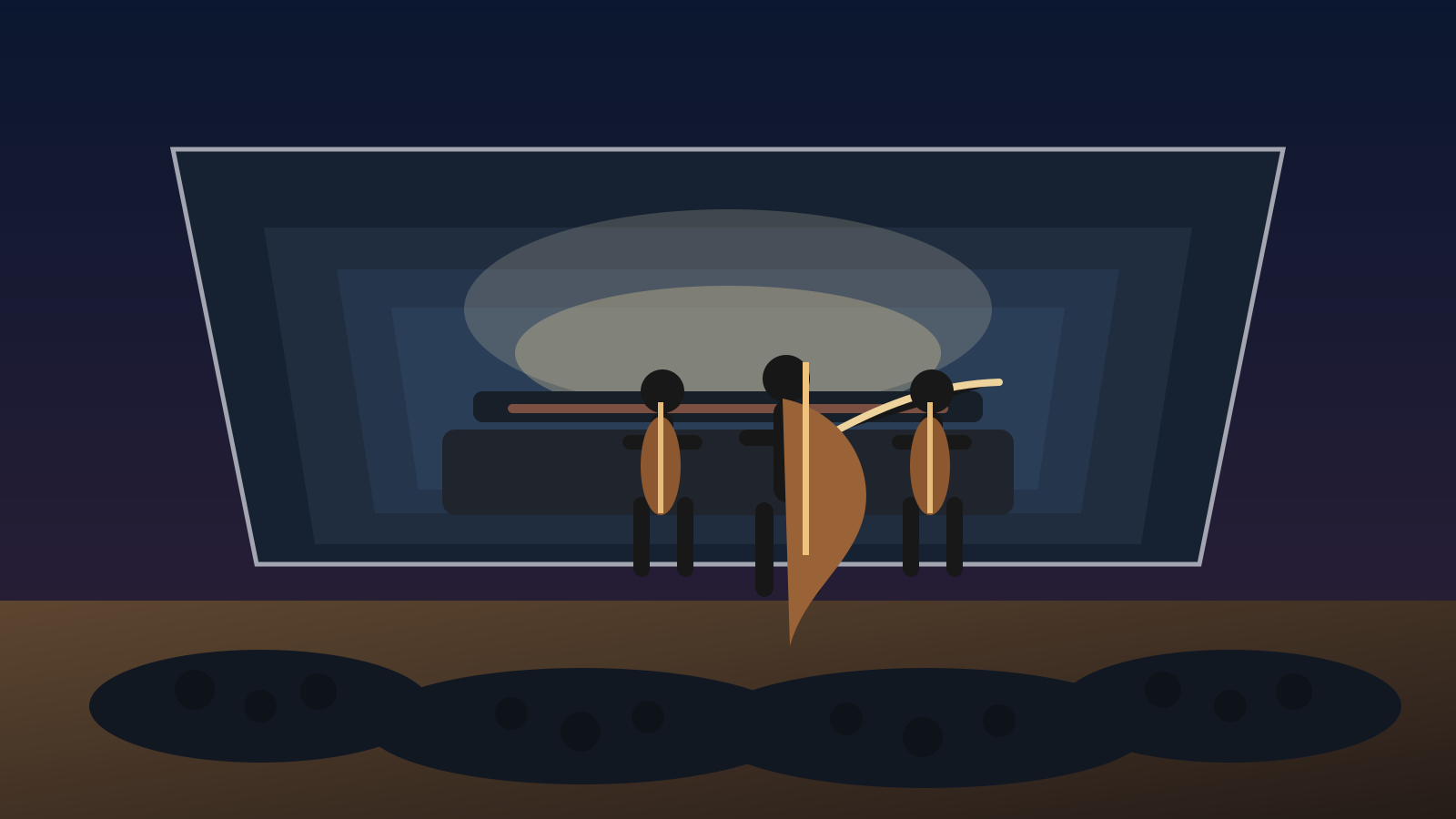
The most interesting part of the Schleswig-Holstein update is not only that applications are open. It is how broad the training promise is. The festival says 100 musicians can be selected from auditions in around 30 cities worldwide, supported by scholarships that cover travel, stay, and rehearsals. The 2026 phases include conductors Teddy Abrams, Andrew Manze, Oksana Lyniv, Stefan Geiger, and Christoph Eschenbach, and one phase is built around playing live to silent film on a big screen. For violinists and violists entering the professional pipeline, that is a practical signal. The market increasingly rewards players who can move between standard repertory, stylistic discipline, camera-aware performance, and collaborative flexibility without losing quality.
Tanya's performer take: the silent-film component is the detail I would underline. Young string players are no longer training only for the old concert script. Timing, visual awareness, and adaptive ensemble work are becoming part of the real job.
What is Music Academy of the West doing right this week?
It is letting the public watch the pipeline while it is happening. The academy's current 2026 Summer Music Festival & School runs from June 17 to August 8 under the banner "American Mosaic," with premieres, core repertoire, teaching artists, and fellows all presented inside one visible system. On the homepage right now, that broad mission turns immediately into concrete dates: June 24 chamber recitals from the High School Intensive, June 25 the Dvořák Eighth finale, and June 26 a String Quartet Showcase in Hahn Hall. That matters because string culture grows faster when training is not hidden behind institutional walls. Audiences get to see emerging players as active performers, and young artists learn that public communication starts before the major-career stage.
Tanya's performer take: this is strong content logic as much as strong education logic. When an institution makes development visible in real time, it creates better future artists and a better-informed audience at once.

What should violinists, planners, and music fans watch next?
- Watch which violin-led shows are being sold as complete worlds rather than as one-song curiosities.
- Track how often presenters frame orchestral collaboration as core programming instead of prestige decoration.
- Pay attention to youth and academy programs that train for timing, screens, and public storytelling alongside pure technique.
- Expect more summer institutions to blur the line between education, content, and live audience development.